Eelgrass

Zostera marina

Eelgrass 
Zostera marina

A Muddy Partnership

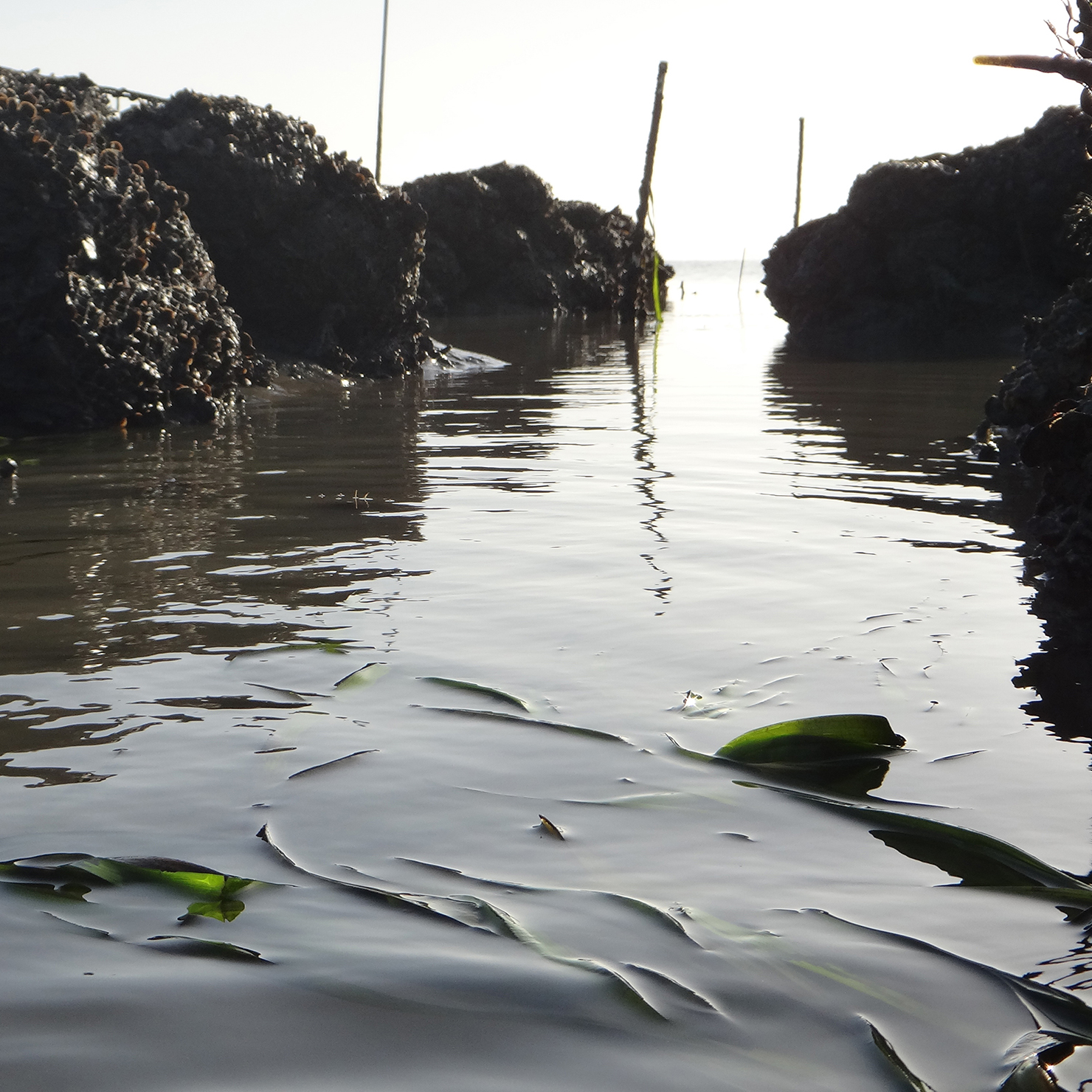
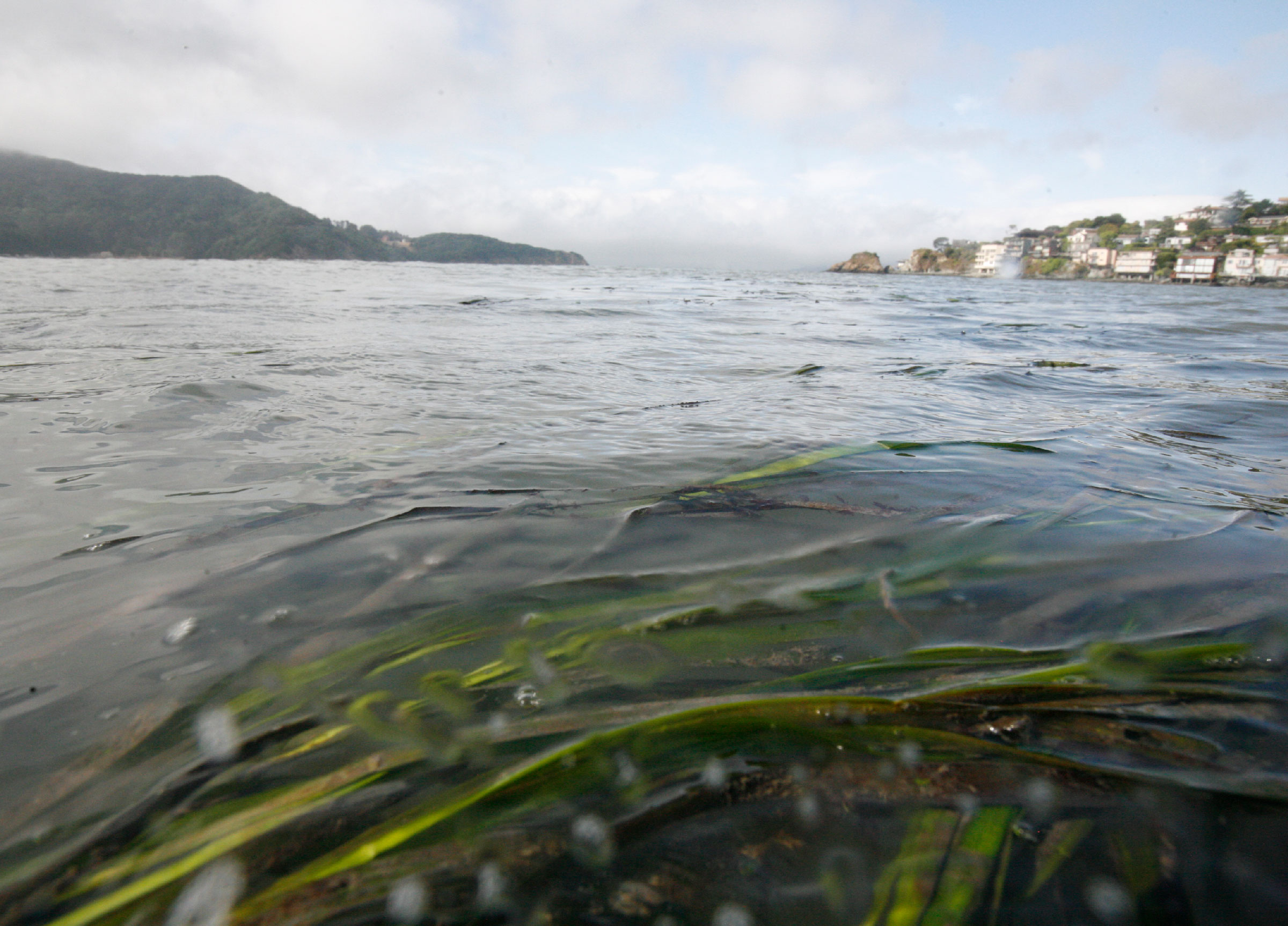
Of the various foundational habitats in an estuary, a few stand out: on the watery side of the ever-shifting shoreline are oyster, seaweed, and eelgrass beds, with salt marshes playing their important role on the drier side of this muddy realm.  Eelgrass is often described as an underwater meadow, but many plots of eelgrass in San Francisco Bay are better described as a forest; it grows in patches of tall blades reaching the surface in deeper water, encountered when kayaking or paddleboarding away from shore.
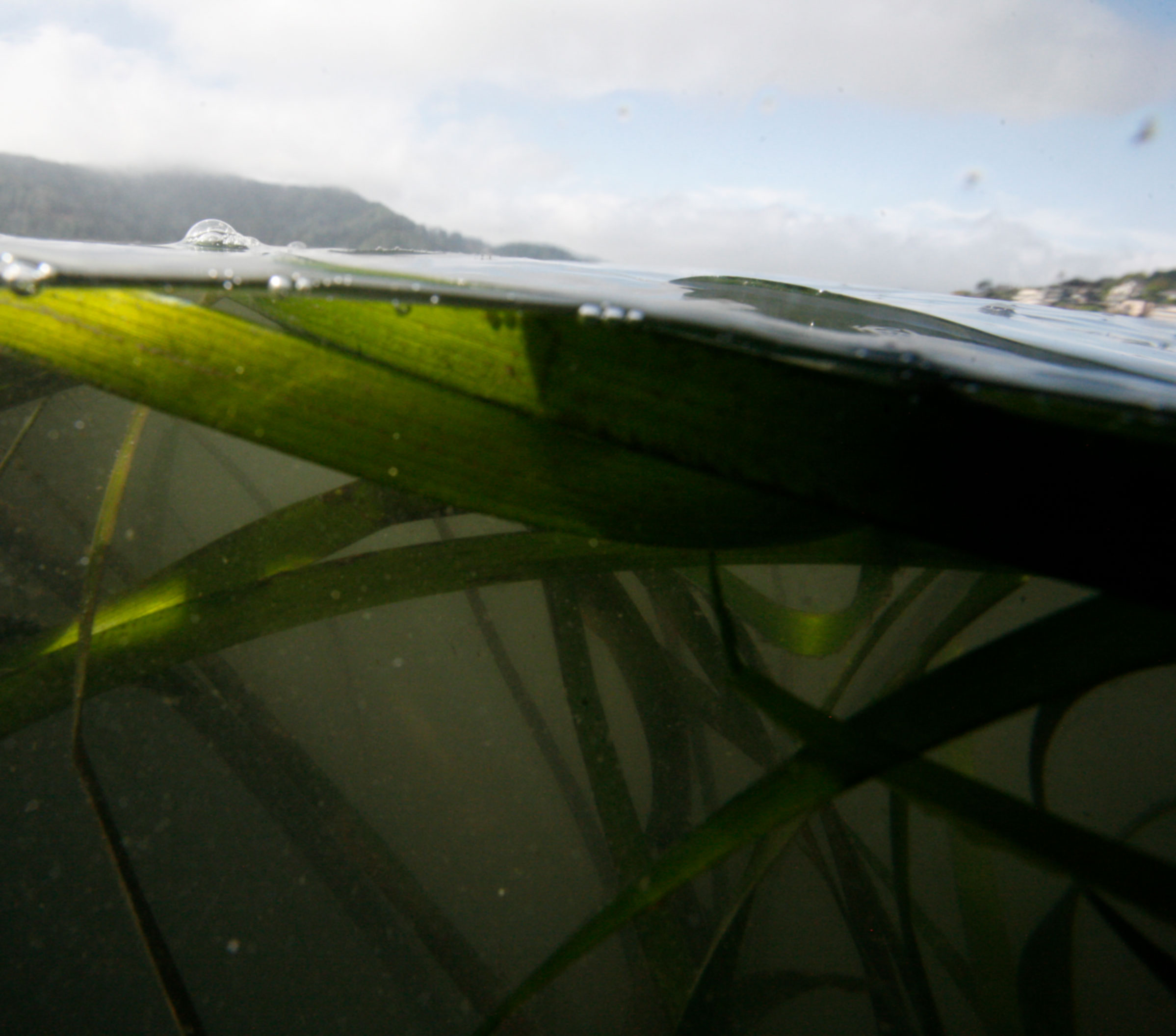
Eelgrass at a Living Shoreline project.

Photo by Greg Lorenz

Eelgrass is actually a flowering plant, that evolved from land back into salt water. As either a meadow (such as the Richmond shorelines in the East Bay) or forest groves (in Richardson Bay off Sausalito), the wide, brilliantly green blades of eelgrass are important players in the health of the Bay.

flowering blade of eelgrass

Eelgrass in the Bay

Photo by Ralph Pace

Habitat-Creating Wonderworld

Eelgrass grows in the muddy bottoms of estuaries, turning ‘just mud’ into hyper-productive habitat. Eelgrass needs full sun to photosynthesize efficiently, so it stays in shallower waters or needs clear water if in deeper territory. These eelgrass beds have been dubbed the “lungs of the sea”—it is estimated that one square meter of seagrass can produce ten liters of oxygen every day. This is an enormous rate of primary production and nutrient cycling for the surrounding area. Eelgrass is also considered an ecosystem engineer; it modifies its surroundings to make coastal habitats more amenable not only to itself but to countless other organisms; it might better be characterized as “the Serengeti of the sea.” An entire raft of invertebrates survive in and amongst the blades of Zostera as well as in burrows dug into the sand accumulated around its roots: shrimp, crabs, worms, and small crustaceans, which in turn are a grocery store of goodies for varied shoppers, from juvenile rockfish to leopard sharks, as well as many kinds of ducks and other water birds.

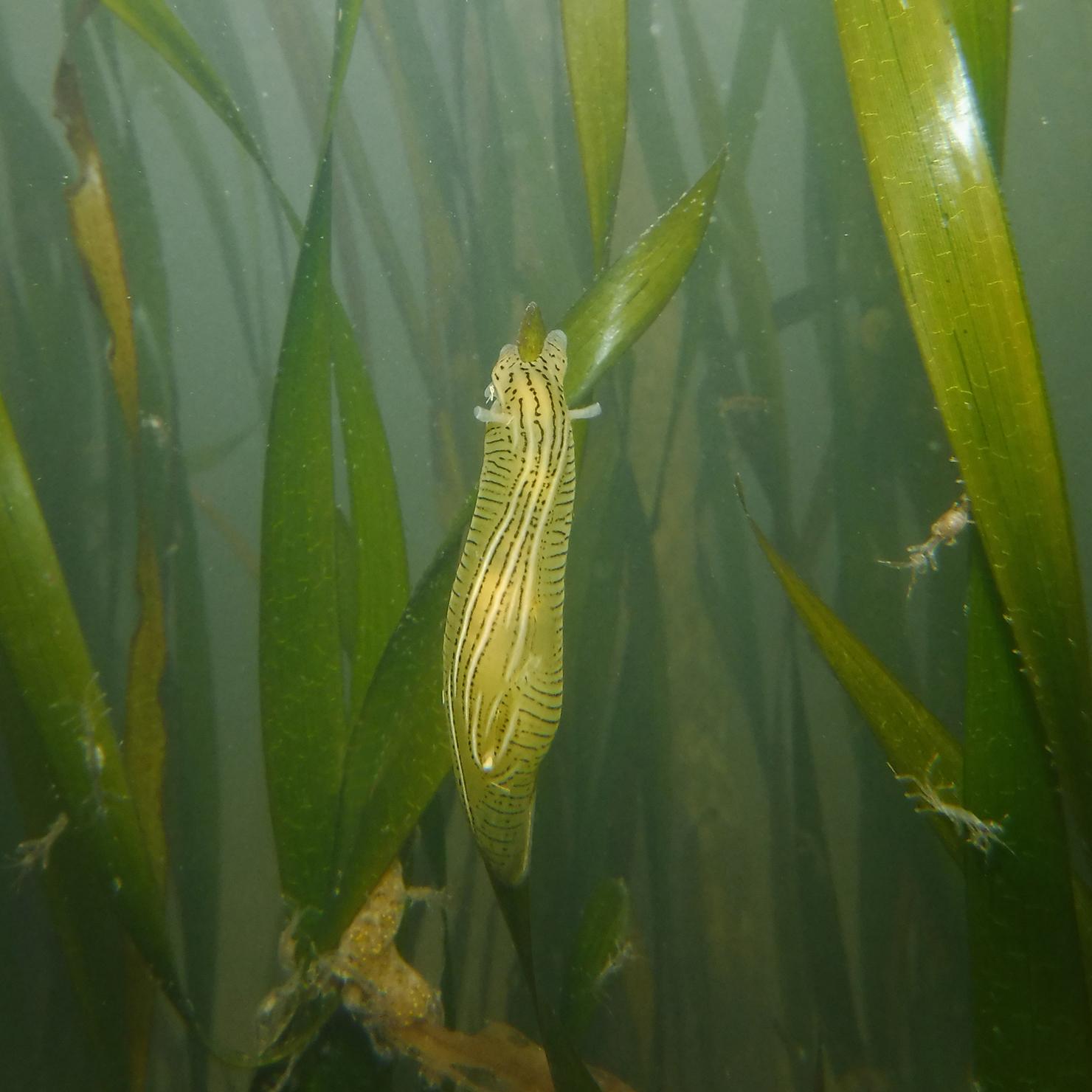
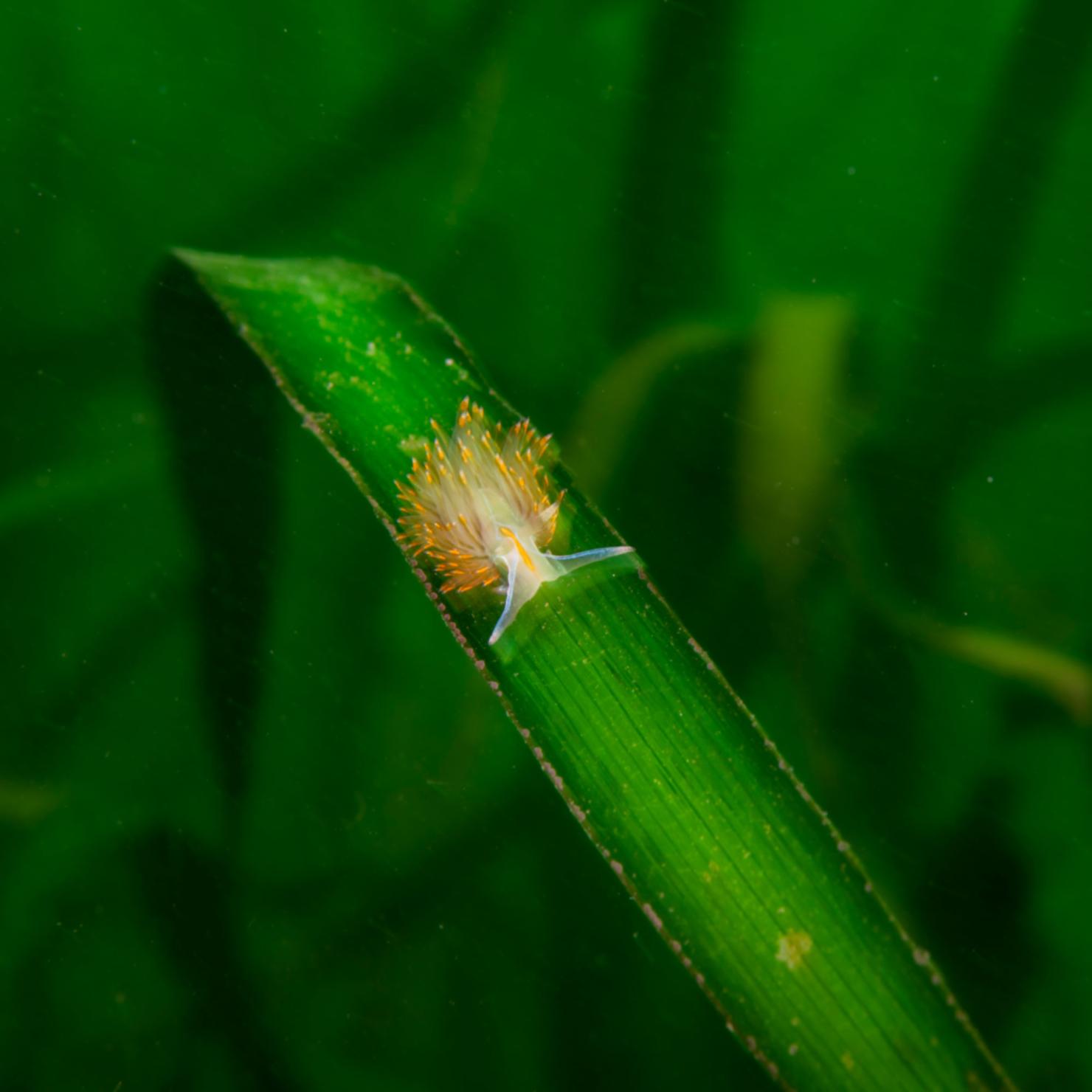
Eelgrass sea hare

Eelgrass sea hare at Bodega Marine Labs

Photo by Josie Iselin

The eelgrass sea hare, Phyllaplysia taylori, lives and reproduces exclusively on the long Zostera leaves, its coloring making it hard to spot. In return for rent, this sea hair eats the algal growth that can block sunlight, a huge boon to the photosynthesizing eelgrass which can then produce the oxygen needed for these tiny respirators to keep up their enterprising work as algal vacuums. This delicate balance between oxygenators and respirators is just that—delicate. It can be thrown off by any number of factors, with agricultural run-off and resulting eutrophication being one major factor. Pacific herring roe also attach to Zostera blades, making it an essential nursery for the herring fishery.

Restoration involving both oyster shells in hanging bags, and eelgrass outplanting.

Photo by Ralph Pace

Eelgrass & Olys

A True Blue Partnership

Eelgrass grows in the mud and sediment and Olys need bits of shell, cobble or hard structure. When an area of shoreline has both, such as a Living Shoreline restoration project, with eelgrass growing outboard in subtidal water and Olys growing inboard on the shallower riprap or tidal cobble, great things happen. Experiments prove: eelgrass prevents erosion—its roots and rhizomes allow sand and mud to accumulate—and traps the sediment that might otherwise inundate the Oly bed, and the Oly bed can, in turn, reduce sediment loss and mitigate wave action closer to shore. Both eelgrass and Oly beds create habitat for different types of organisms, from sponges to leopard sharks; they are both feeding grounds and larval nurseries, creating the base of the food web. Olys filter and clarify the water around them, making their location attractive to eelgrass, which is always searching for clearer waters to photosynthesize more efficiently. Eelgrass beds often migrate towards oyster farms!

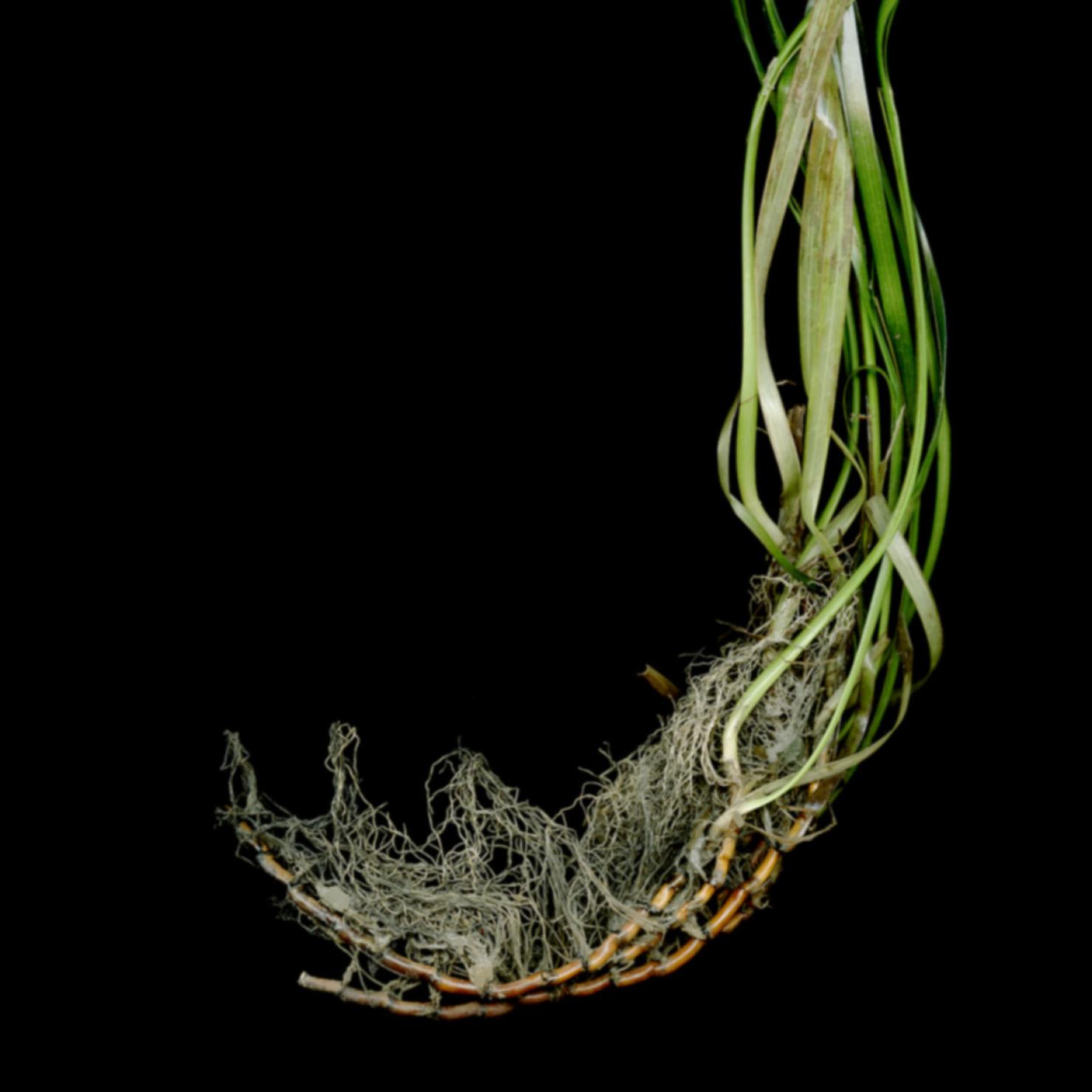
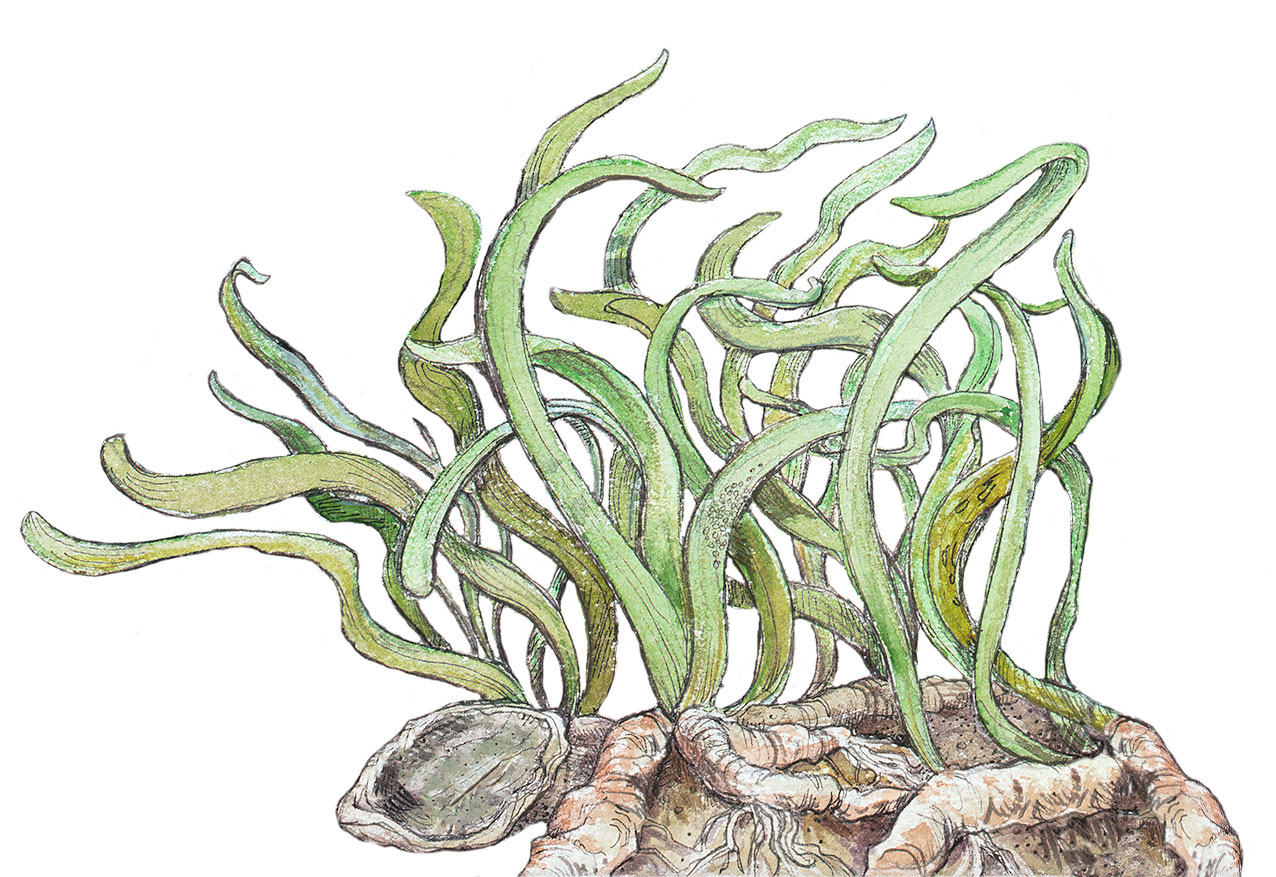
eelgrass roots

Eelgrass rhizomes are roots.

Photo by Josie Iselin

The partnership also adds resilience in the face of ocean acidification. Primary production uses carbon dioxide in the photosynthetic process, so the pH tends to be higher (less acidic) within eelgrass forests (during the day), a potential boon to nearby oysters and other mollusks and bivalves in the shell-building business. And both eelgrass and olys sequester carbon—eelgrass in their rhizomes and the undisturbed sediment they grow in, and Olys in the growth of their calcium carbonate shells. They seem to do this better together than separately. But each of these carbon storage systems takes time, lots of time. They are not quick. This is one reason it is important that eelgrass and Oly beds remain undisturbed.

Flowering Plant, Not Seaweed

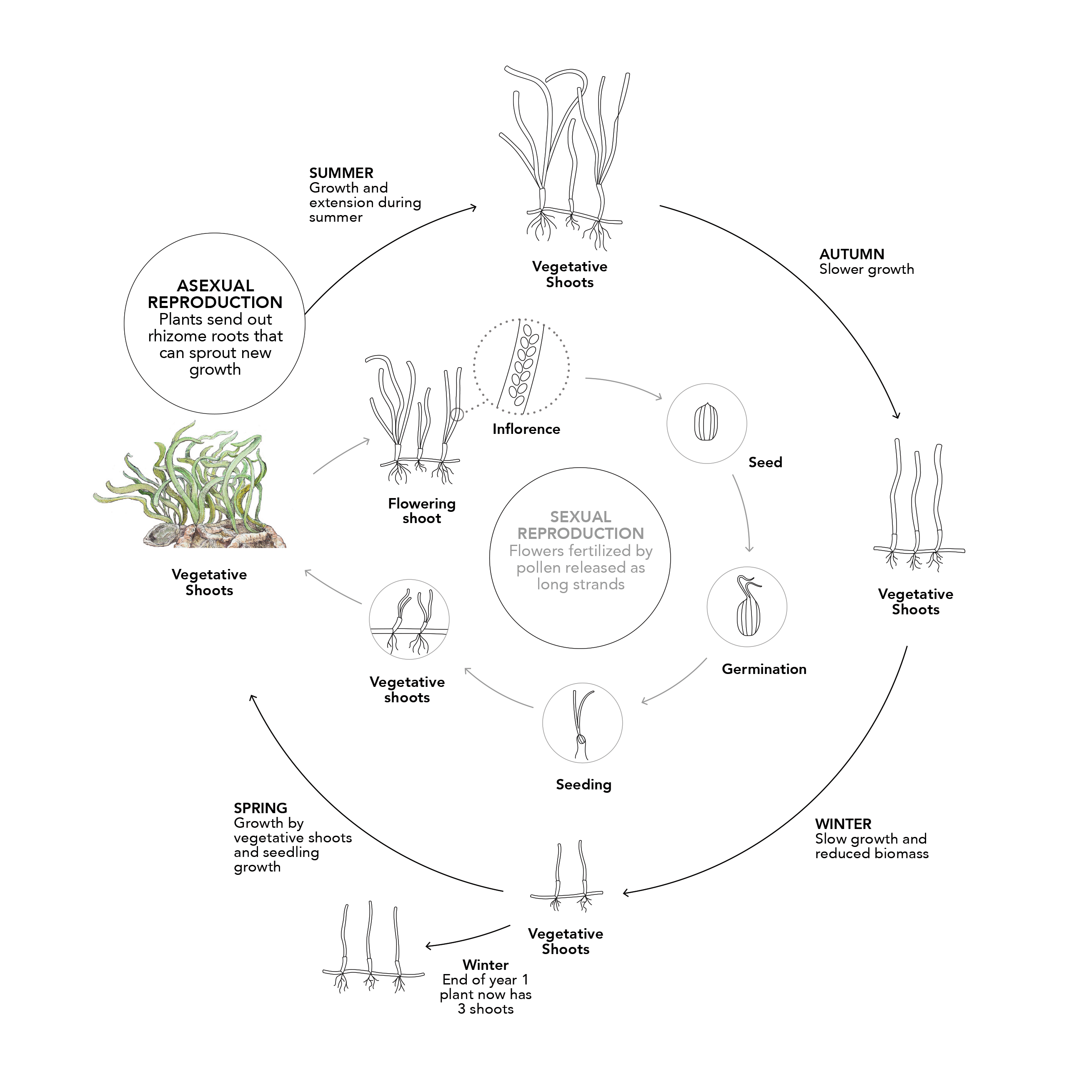
Zostera marina is a marine plant, not a marine algae (seaweed). It evolved from a vascular plant on land back into the marine environment, dropping or adding genes to allow it to thrive in salt water, and its rhizomes act like roots, pulling nourishment from the sediment in which it grows. It is a flowering plant, producing seeds, but its reproduction is most efficient by propagation; its rhizomes will spread and expand. Restoration work is done by collecting samples of blades and rhizomes from a variety of eelgrass beds to make sure genetic variation is incorporated into the new patch of eelgrass.

Baby herring just released from their egg

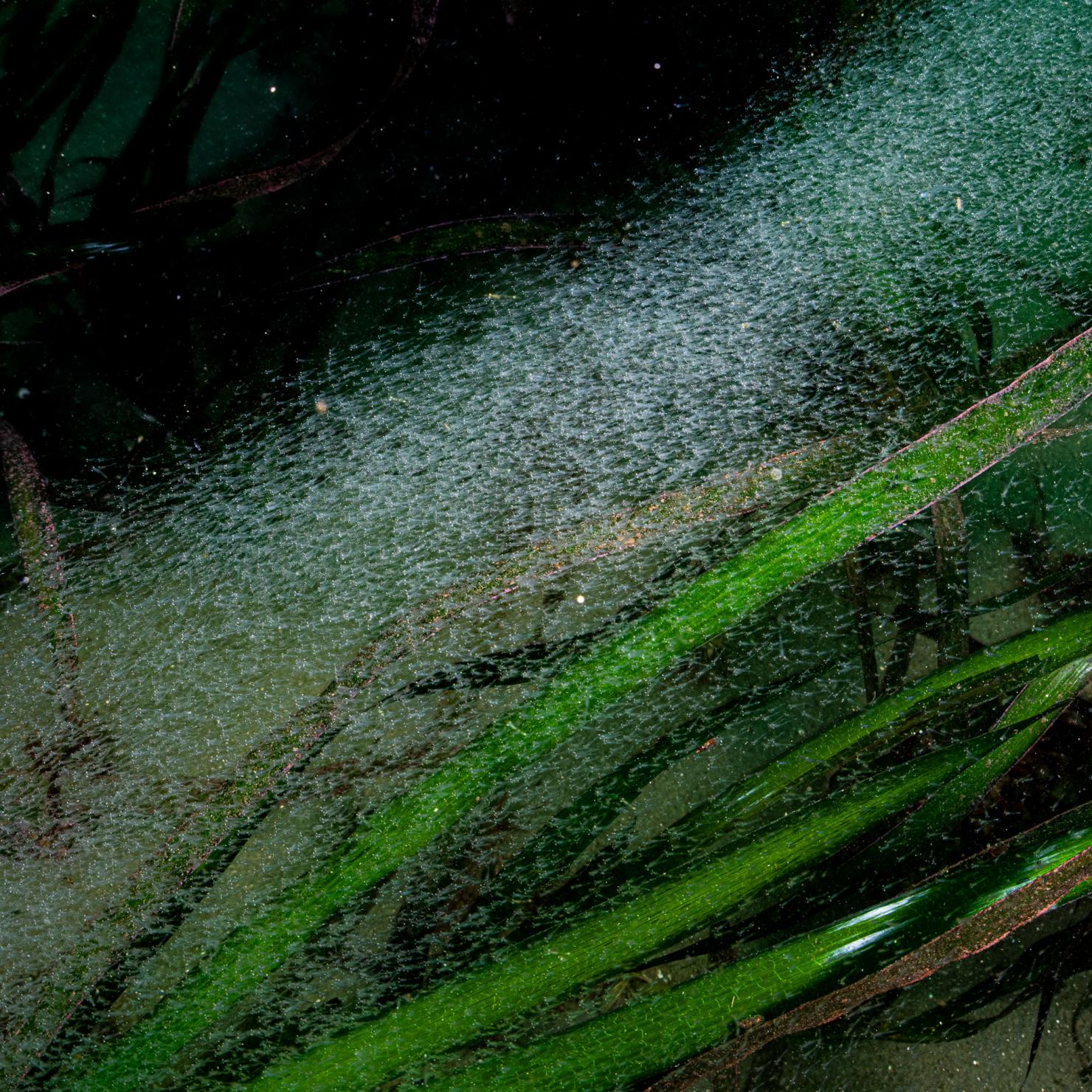
Baby herring just released from their eggs, the famous roe that sticks to eelgrass blades around San Francisco Bay. Herring, as roe and then as just-hatched juveniles are an important food source at the lower level of the food chain.

Photo by Ralph Pace

At Home in the Shallows

So many fish, so many birds! A list of just some of the fish that are believed to feed on smaller organisms in eelgrass beds in the San Francisco Bay are perch (shiner, white, dwarf, black, walleye), Goby (bay, cheekspot, arrow, yellowfin, chameleon), sculpin (Pacific staghorn, woolly), gunnel (saddleback, rockweed, penpoint), kelpfish (spotted, striped), Bay pipefish, three-spine stickleback, juvenile rockfish, juvenile California halibut, English sole, and topsmelt. Some of the larger predators include Leopard Sharks and Bat Rays. A Go-Pro set up in an SF Bay eelgrass bed recorded a crazy number of diving ducks and other birds in the eelgrass feeding, including osprey whose talons would appear underwater snatching fish, and Brant’s geese whose short neck only allows them to forage the tops of the eelgrass, leaving the important meristem below for ongoing growth.

Eelgrass on the water

Photo by Greg Lorenz

Estuarine Recovery Superstar

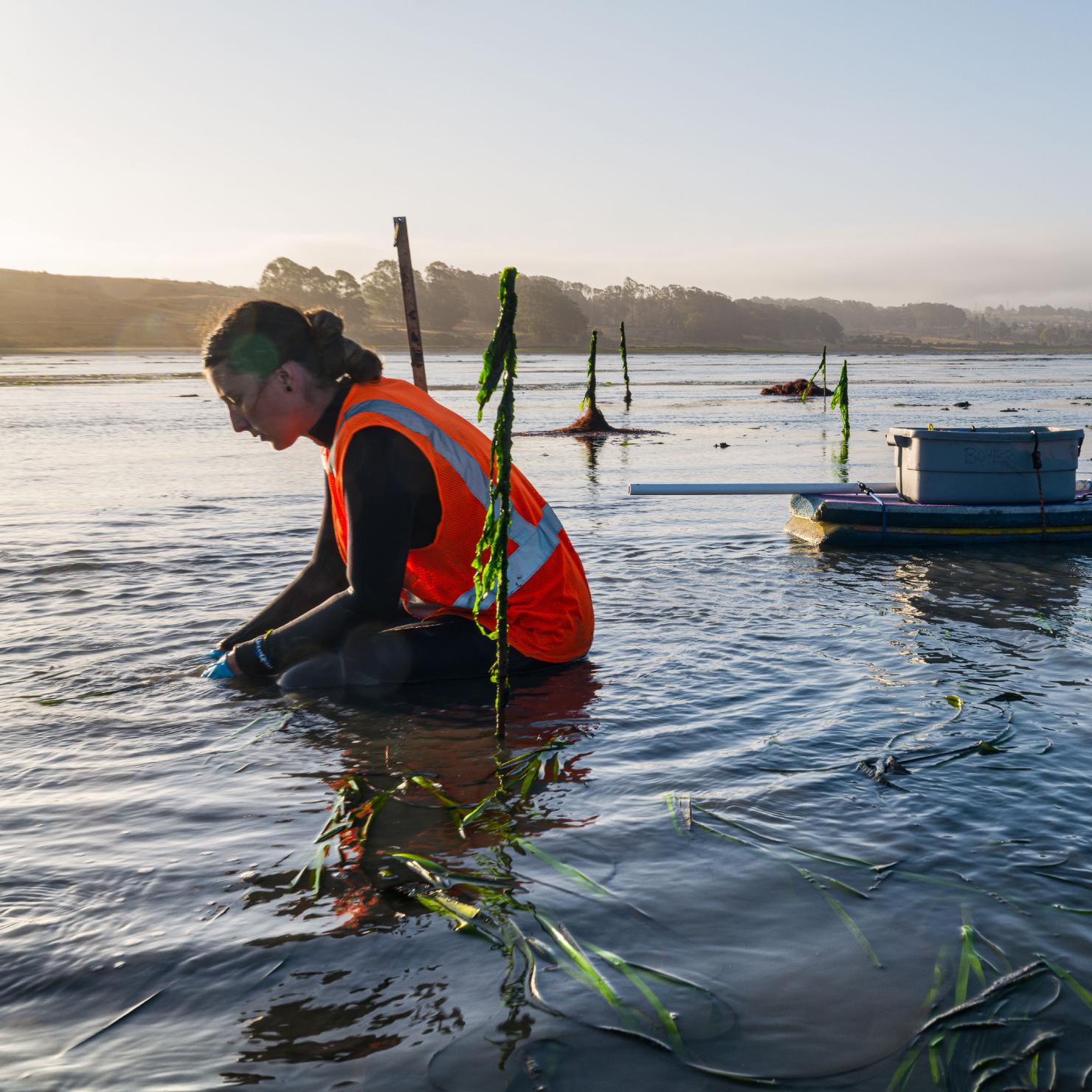
Eelgrass restoration has proven its worth over and over. Kathy Boyer’s lab at the Estuary and Ocean Science Center in Tiburon has been at the forefront of eelgrass recovery efforts for decades. Eelgrass reproduces both by asexual propagation and as a flowering plant producing seeds. But recovery efforts have only been done by transplanting shoots; the seeds of the Zostera flower are not used to cultivate or breed eelgrass for outplanting. In the process, it is important to collect shoots for relocating from a widespread swath of existing eelgrass beds to ensure genetic diversity in the new bed. To this end, it is perhaps most important to protect and preserve existing eelgrass beds. And there is now evidence that restoring eelgrass and oyster together benefits both organisms to a greater extent than if put in 
place individually.

Eelgrass restoration worker in the Bay

Eelgrass restoration at work.

Photo from SCC

“To keep every cog and wheel is the first precaution of intelligent tinkering.”

Aldo Leopold

Maintaining the healthy eelgrass that is there means careful attention to where anchors and moorings are located. When an anchor is pulled up, it will rip out eelgrass and release the carbon in the disturbed sediment. In bays such as Richardson Bay, there has been a careful assessment that permanently anchored boats damage eelgrass beds, the anchor and chain acting like a lawn mower right below each boat. In fact, aerial views of the bay once anchor-out boats were removed show bare circles amidst the eelgrass where anchors once were. If left undisturbed, these empty patches should fill in quickly.