Estuaries

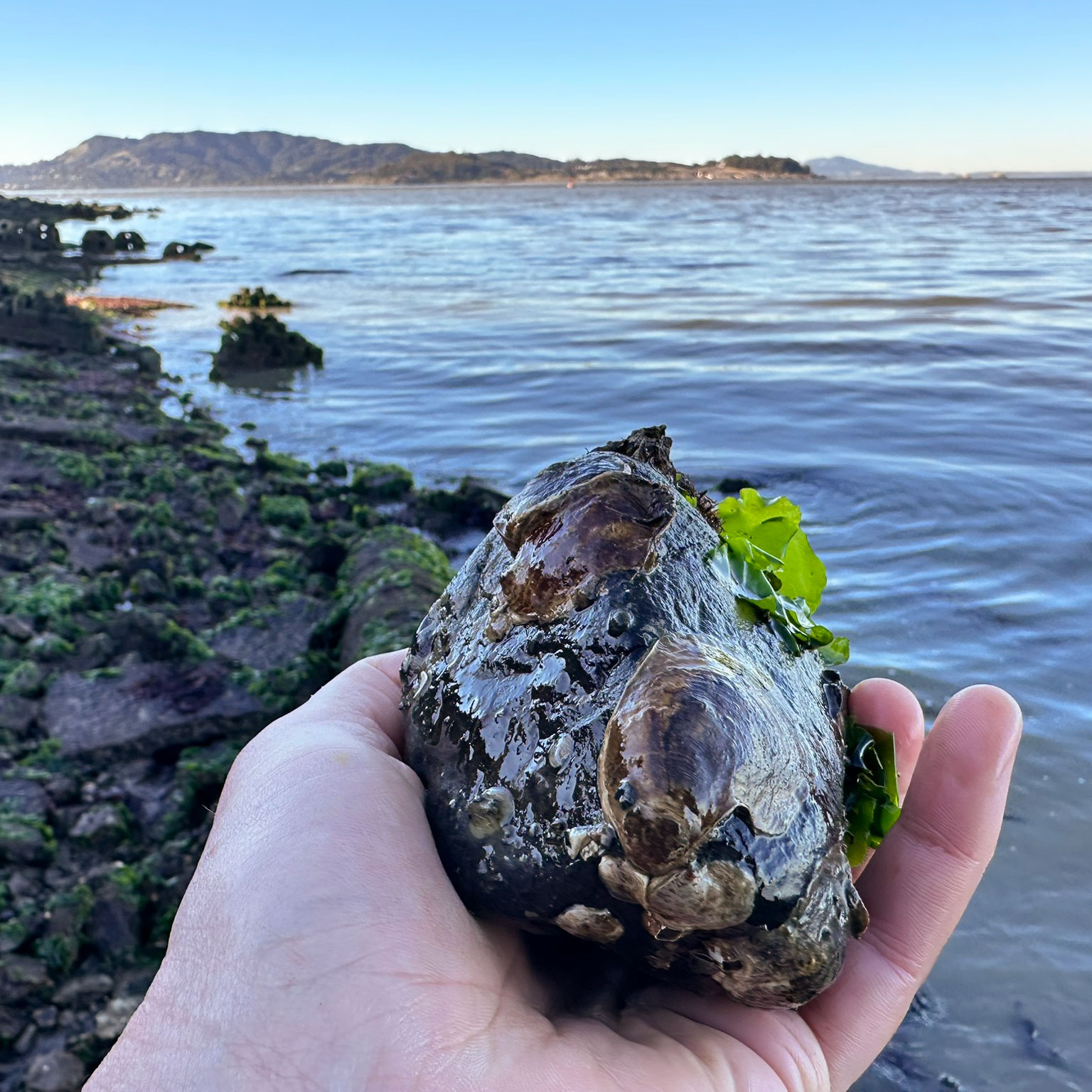
Photo by Greg Lorenz

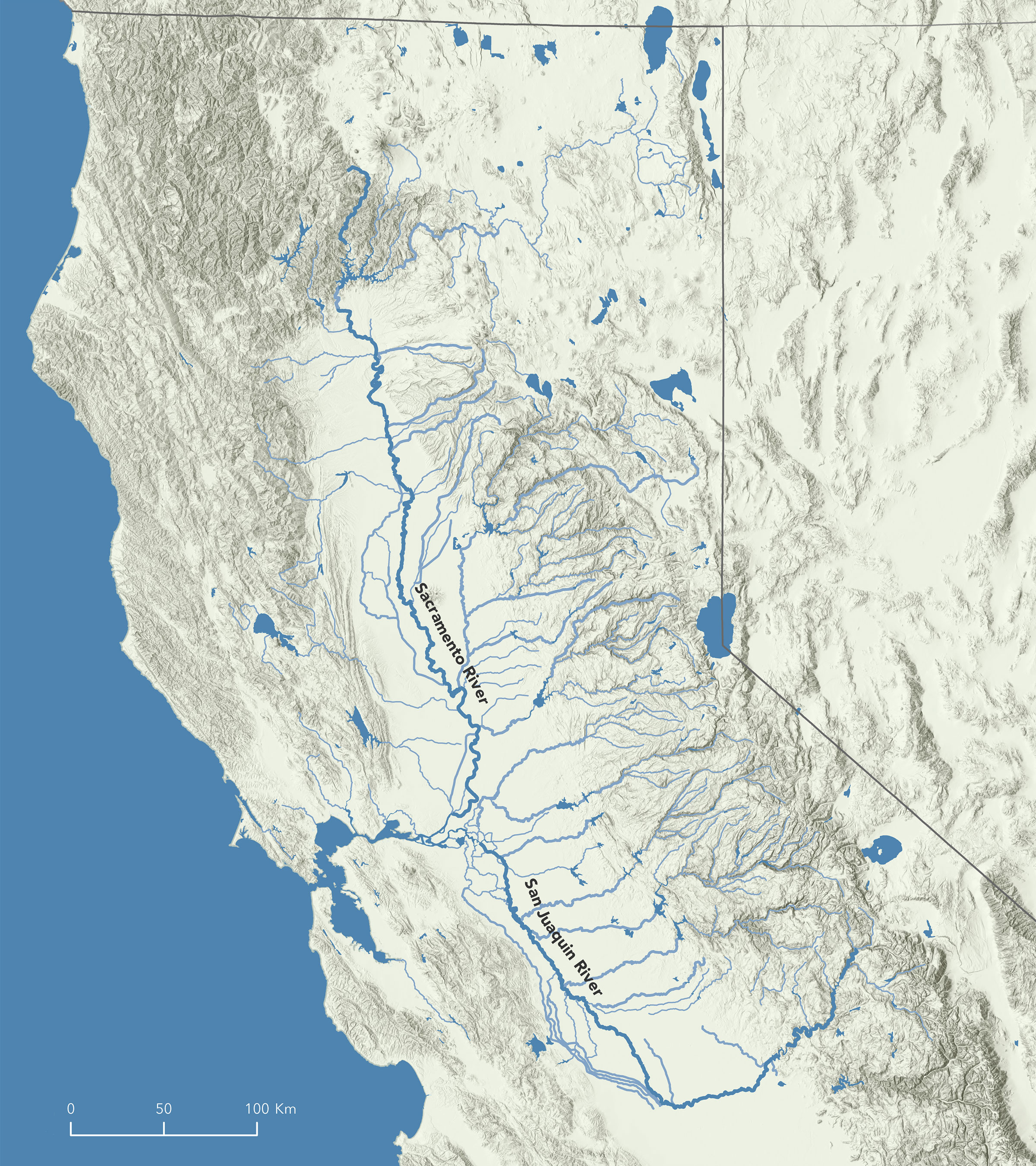
California Watershed Map: Virtually all of the rivers and tributaries coming out of the Sierra Nevada collect into a single estuary: The San Francisco Bay.

Map: hydrography data: California Dept. of Water Resources, imagery: ESRI

A Place Where Land, Rivers, and Ocean Mix

Estuaries are where rivers come from higher elevations and enter the ocean realm, mixing their nutrient-rich fresh water with the ocean’s salty water. Estuaries are where the ocean enters into terrestrial territories meeting river water in tidal pulses, pushing brackish, salty water into marshes of cordgrass, bringing ocean nutrients into tidal mudflats, oyster beds, and eelgrass meadows.

The San Francisco Bay-Delta is one of the most dynamic and remarkable estuaries in the world. It is where the Sacramento River, originating from the north and fed by the American and Yuba Rivers, and numerous tributaries, joins the San Joaquin River from the south, fed by the Stanislaus, Tuolumne, and Merced rivers coming out of the high Sierra Nevada mountains, and flows to the sea. The Pacific Ocean, in turn, comes through the narrow Golden Gate, bringing deep-water upwelling nutrients from the offshore Greater Farallones Marine Sanctuary into the Bay with each 6-hour cycle of incoming and outgoing tides. These waters are pushed up past Alcatraz and Angel Island into the North Bay towards the Delta, as well as south into the shallow waters of the South Bay.
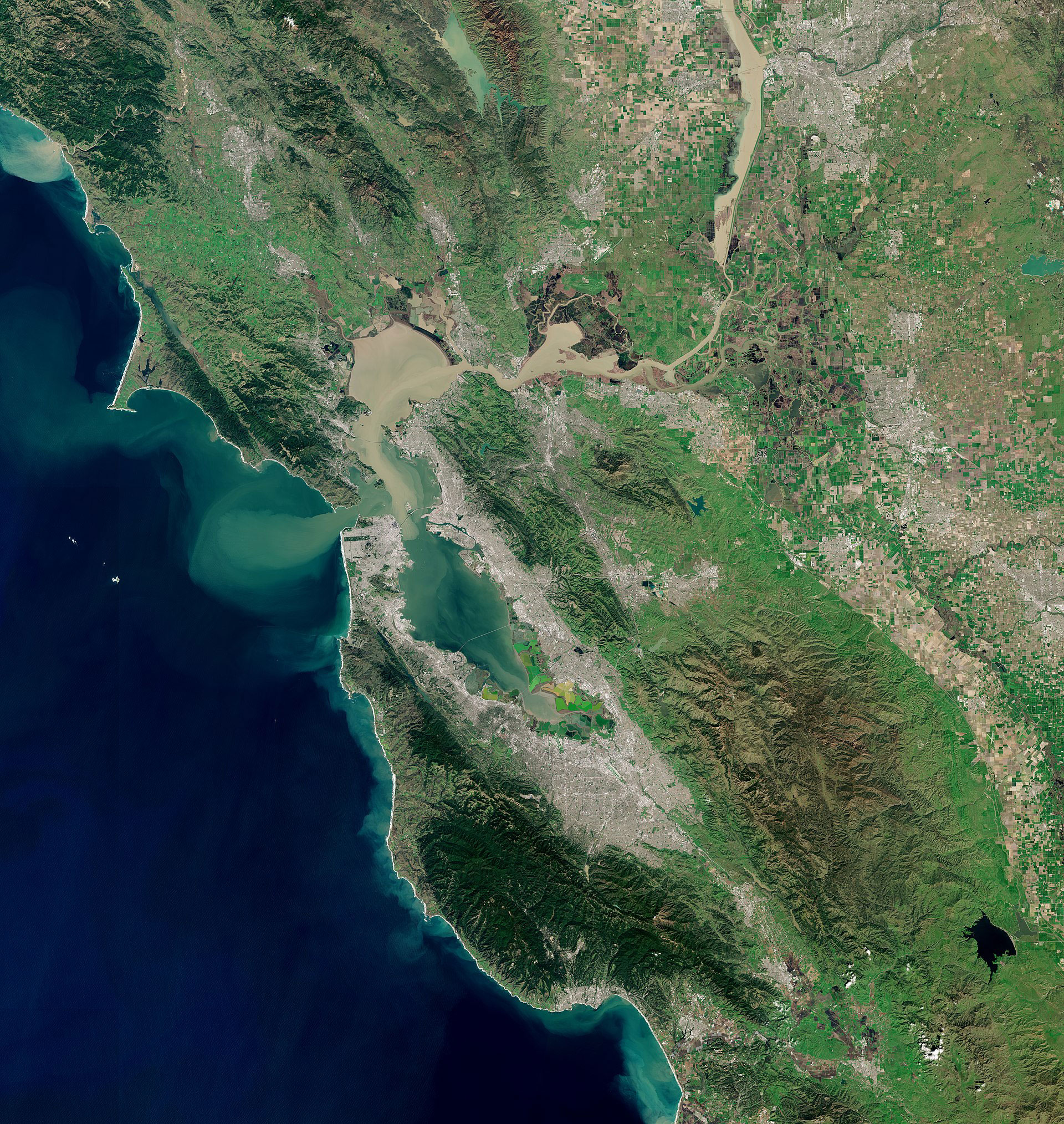
The Bay from Above: The immense amount of brown, muddy sediment can be seen flowing down through the Delta into the Bay, almost to the Golden Gate.

Map: Copernicus Sentinel-2 satellite, ESA

Always in Flux

The intensely dynamic nature of San Francisco Bay waters is an extreme example of estuaries everywhere. Change is constant. There is the mixing zone of salt and fresh water that shifts daily with the tides but also seasonally with the rains and annual snow melt. A dry year will result in a saltier bay, while in a wet year the Bay will be fresher. More or less nutrients flowing can have both beneficial and harmful results. Sediment movement from the rivers into the Bay, or from dredging or construction, has profound effects on life in the Bay. This complex estuary, which is home to so many people and organisms, is a grand balancing act where the plethora of both geophysical and socio-human factors is always in flux.

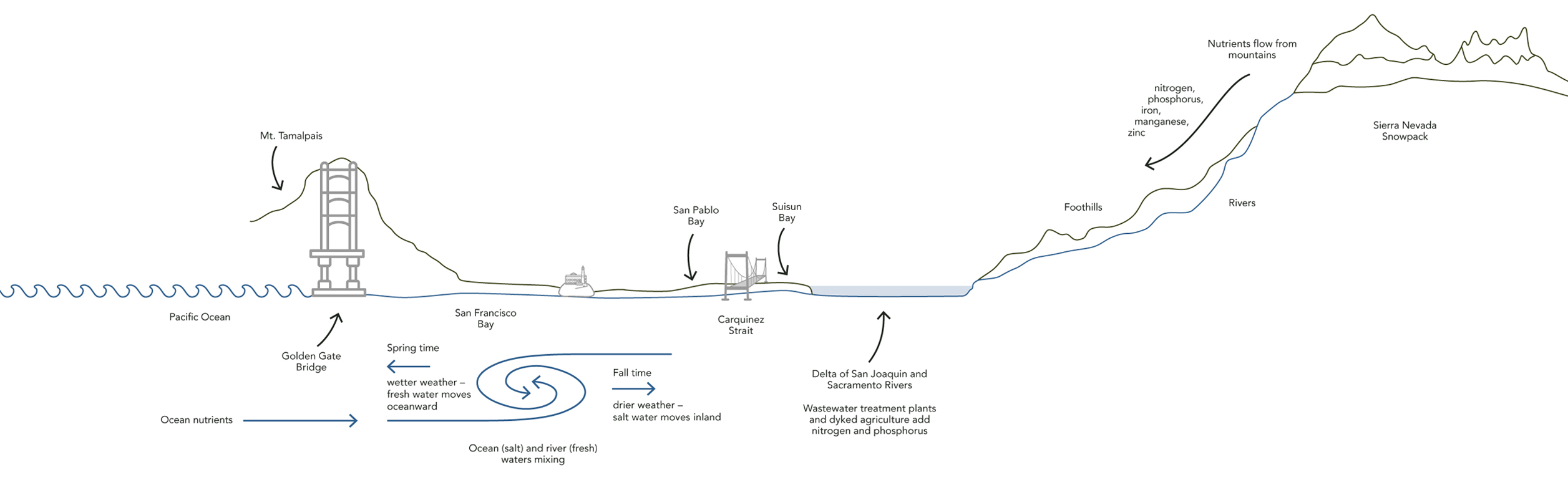
From Summit to Sea: Cross-section of the Sierra Nevada mountains to the Pacific Ocean: nutrients come into the Bay from the mountains and from the ocean. Salinity in the Bay is seasonal. The drier fall means a saltier Bay while the wet spring means a fresher bay. Each tidal pulse also changes salinity.

The Flow of Nutrients

Unlike Oregon, where seven great rivers flow directly into the Pacific Ocean, hundreds of California’s rivers come out of the Sierra Nevada mountains and all converge and flow into the delta of the Sacramento and San Joaquin rivers and on into a single estuary to the ocean: the San Francisco Bay. These rivers, hopefully fed by generous snowpack each spring, pull nitrogen and phosphorus from the rocks and earth of the mountains and foothills and agricultural territories to the east, and transport them downstream into the Delta and Suisun Bay, through the Carquinez Straits, into San Pablo Bay, and on into the greater San Francisco Bay where they mix with the nutrients from ocean waters. These mineral riches, including iron and manganese and zinc, form the building blocks of the prodigious life in the bay. They drive a complex trophic food web at the bay’s edges. Olys and eelgrass are foundational to this web of life, transforming these essential minerals into protein and calcium carbonate shell (Oly) or as primary production using sunlight via photosynthesis (eelgrass). Each, in turn, creates habitat for countless other organisms.

A Great Place to Live / A Great Place to Visit

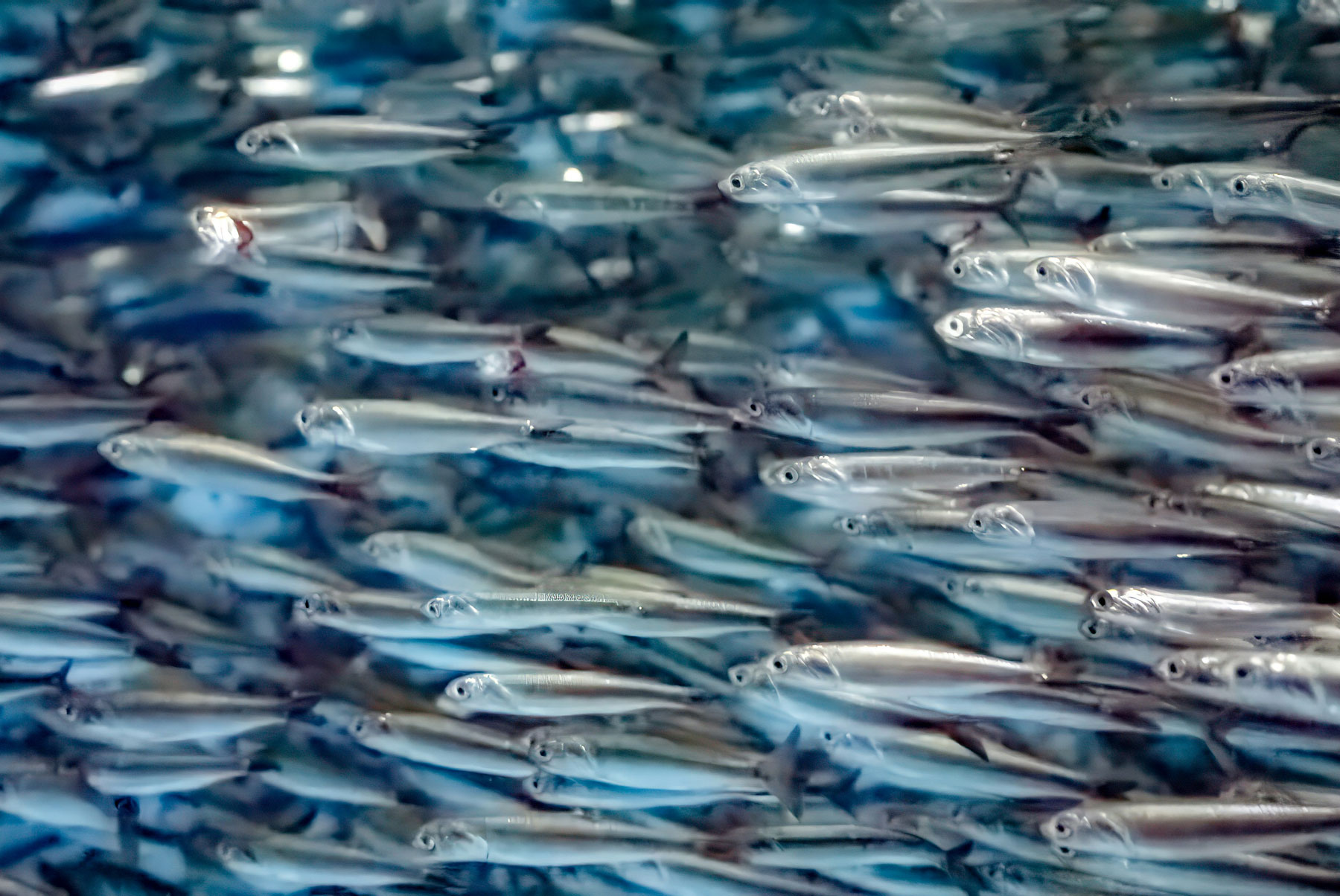
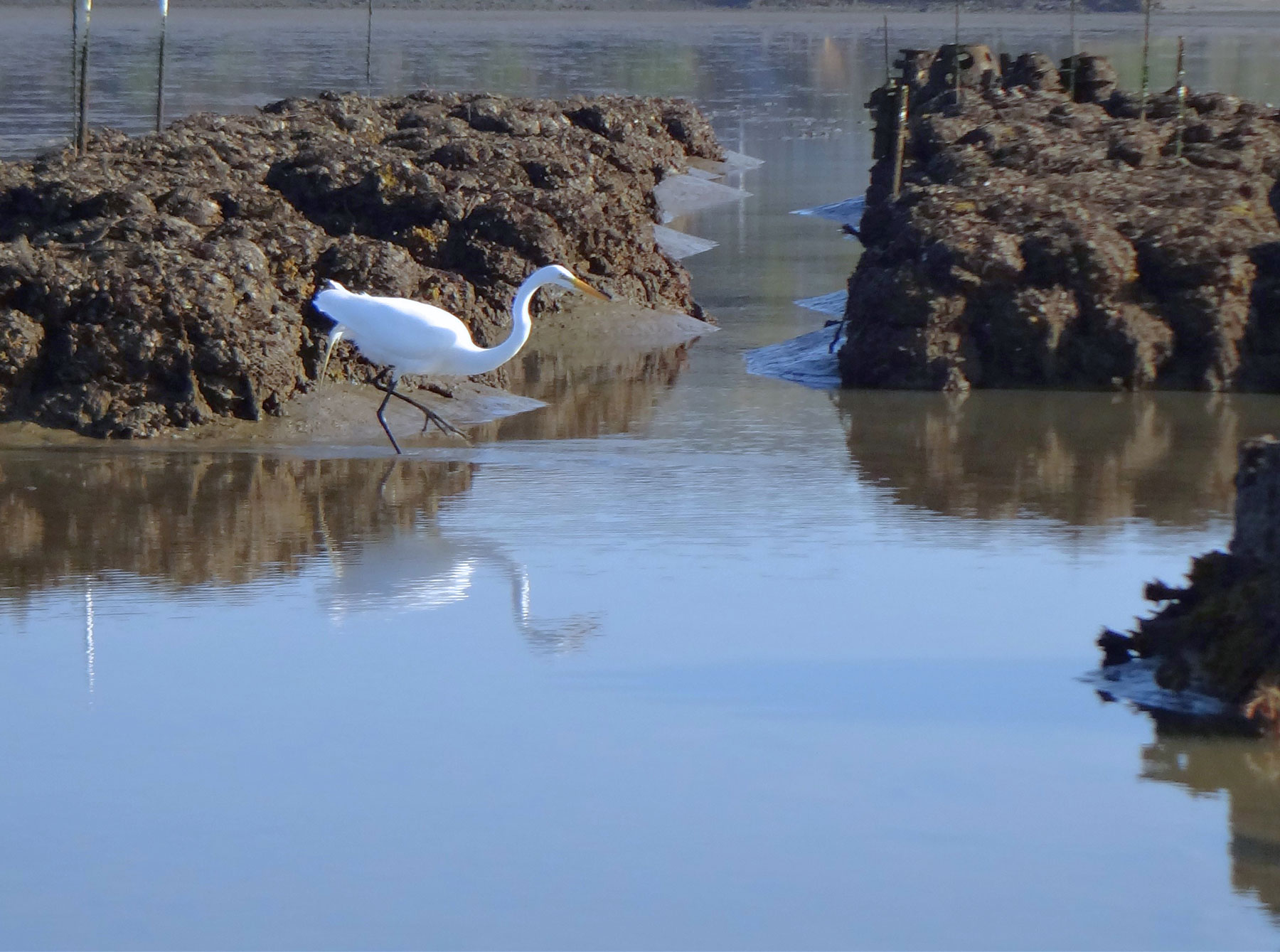
Millions of people call the edge of the San Francisco Bay home. Ostrea lurida (Olympia oysters) and Zostera marina (eelgrass) would too, if they could. So would clams, worms, seaweeds, and countless organisms living in the tidal margin of the bay, as well as resident dabbling and diving ducks like the Ruddy duck, leopard sharks, bat rays and the blue heron that parks itself on the derelict dory tied to the old houseboat. And like the flood of visitors that come through the Bay Area each year, migratory shorebirds, ducks and geese, schooling fish, and returning salmon come to the Bay seasonally.

Pacific herring are visitors to the Bay.

Great egrets are a residents of the Bay.

“Waterfowl are conspicuous members of the San Francisco Bay Area avifauna. Situated near the center of the Pacific Flyway that stretches from Alaska to Chile, the SF Bay and Delta are just over 1,700 square miles. It includes several important hot-spots for migrating waterfowl.”

Jay Vannini, Ducks Unlimited. 2024

A Living Shoreline

Both Above and Below

The dynamic margin of the San Francisco Bay has urban promenades, riprapped mudflats, salt ponds converted to wildlife refuge, airport runways, and multiple combinations of industry side by side with tidal wilderness, such as cobble beaches, seaweed beds, or vegetated shorelines. Above the water’s surface is dominated by human activity, but below is alive with the activity of untold numbers of organisms. The Olympia oyster and Zostera marina, eelgrass, are each a cornerstone of this hidden but productive shoreline community, filtering water, cycling nutrients, and stabilizing sediments. The health of the Bay—its clarity, salinity, and oxygen balance—depends on such quiet workers. They, in turn, depend on a healthy Bay.

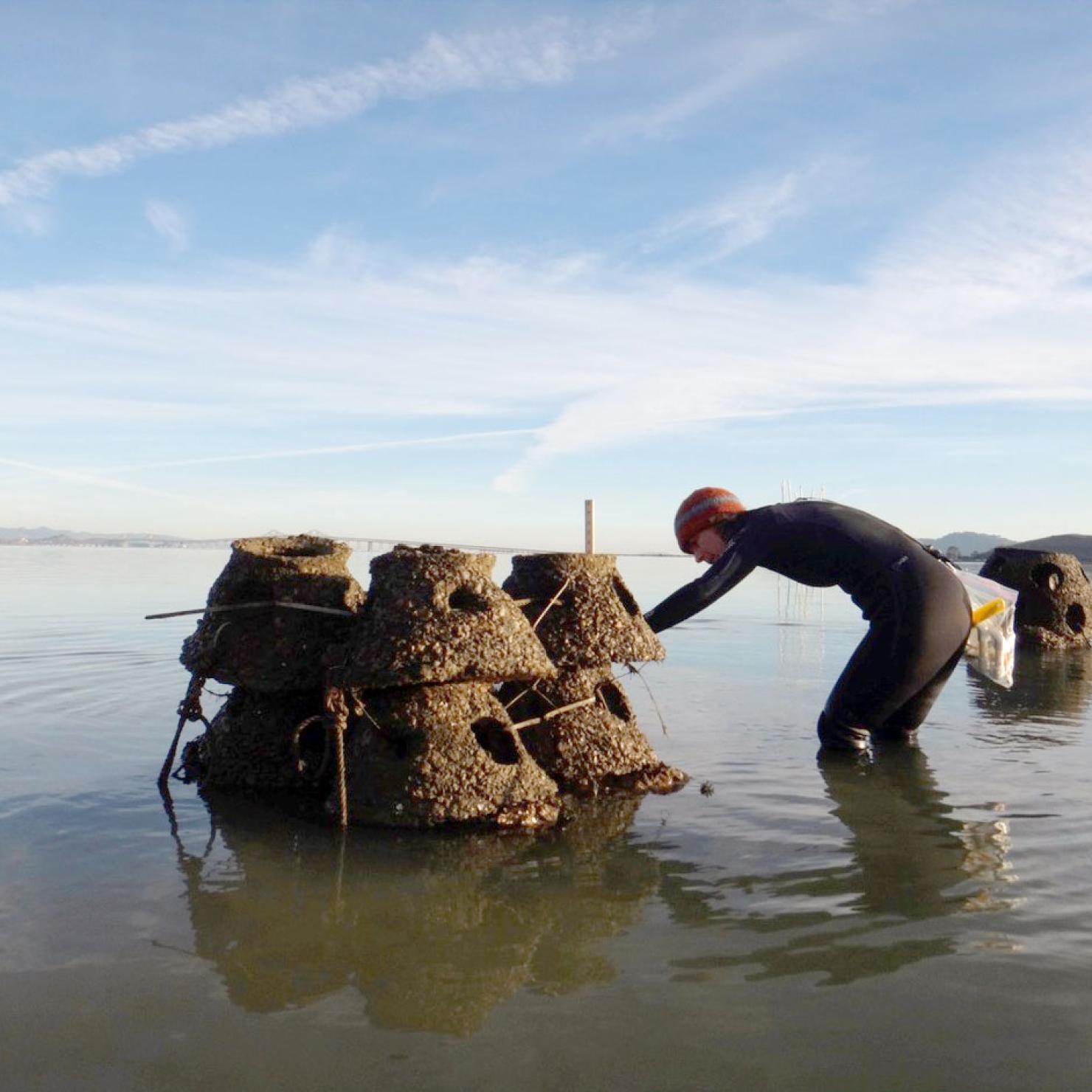
Scientist in bay with artificial reefs

San Rafael Living Shorelines Project

Photo by Marilyn Latta

Maintaining this delicate equilibrium and building shoreline resilience in the face of sea level rise, is the goal of Living Shoreline restoration projects. Living Shoreline sites around the Bay strategically place both transplanted eelgrass and nearshore reefs made of shellbags, reef balls, rocks or other hard material for Olympia oyster recruitment in the intertidal zone; they are designed and monitored to provide both ecological and physical benefits along the shoreline, providing habitat for a diverse suite of organisms to live as well as trapping sediment in the right places and protecting urban shorelines from storms and sea level rise. The small-scale, pilot Living Shoreline projects in San Francisco Bay are helping determine how larger-scale restoration might be best scaled up.

Tidal Dynamics

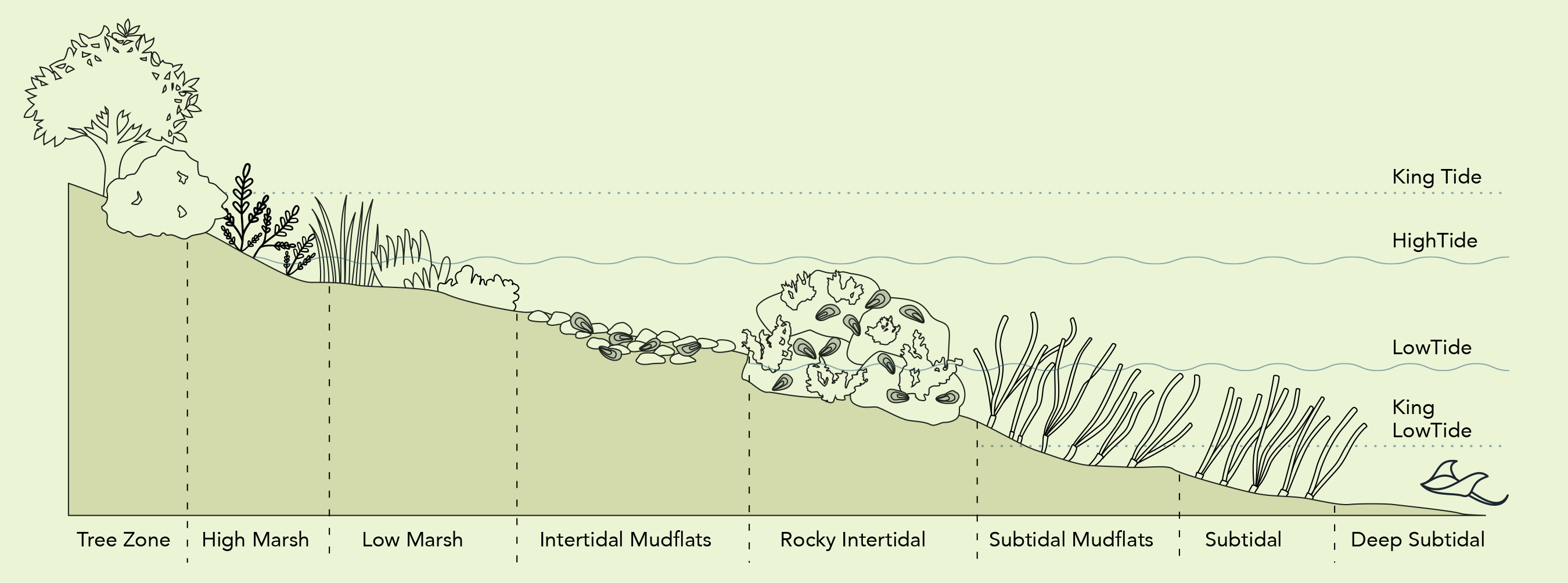
Tides flow in and out of the Golden Gate in six-hour cycles, the heights dependent on the gravitational tug of the moon. When Sun, Earth, and Moon fall into alignment—as they do during the full and new moon—their combined pull magnifies this pulse and the tides rise higher and fall lower, the water’s reach stretching into salt marsh and onto shore. Even more extreme tides, King tides, occur a few times a year. These extreme high tides are seen as a marker of where sea level rise will impact the coast. Oysters and eelgrass are often exposed during the extreme low tides, but Olympia oysters can close up tight, trapping moisture inside of them, surviving well in the mid-tide zone and even when exposed during King low tides.

Photo from SCC

Olys and SF Bay

For those living in and around San Francisco Bay—including San Pablo Bay, Suisun Bay, and the South Bay—the health of the local waters is of utmost importance, and the Olympia oyster is doing its small part to help. There is a broad coalition of agencies, organizations, individual scientists, monitors, and data collectors working to restore wetlands, clean sewage outflows, resuscitate habitats, count fish, and monitor water quality; they all know that Olys could play a larger role in this collaborative venture to restore a healthy Bay. In turn, a virtuous cycle might be established where a healthier Bay would let Olys become even better partners in this ongoing work.

The diversity of kinds of shorelines around the enormous and unique estuary that is The San Francisco Bay allow Olys to find a range of conditions and places to establish themselves, whether rugged rocky terrain under the San Rafael Bridge, or more human-impacted industrialized shorelines. Olys are good at co-existing with human structure and impacts, they can find nooks and crannies in unexpected places to establish themselves. Their positive impact on any zone they inhabit is one of the many fascinating aspects of the Olys’ alluring world.