Olympia Oysters

Ostrea lurida

Olympia Oyster
Ostrea lurida

Oysters are Bivalves

Bivalves are mollusks with two hinged valves, or shells. Clams live in the mud, mussels cling to rocks by their byssal threads, scallops scoot along the ocean bottom, and oysters permanently cement themselves to any hard surface, but preferably on shells, either their own or others. Oysters, unlike their bivalve counterparts, are asymmetrical, with one valve cupped and the other flat. Counter to what seems practical, they lie on their cupped side, flat-side-up. Oysters are breathers; they respirate, taking in oxygen and releasing carbon dioxide.

Smaller than Most

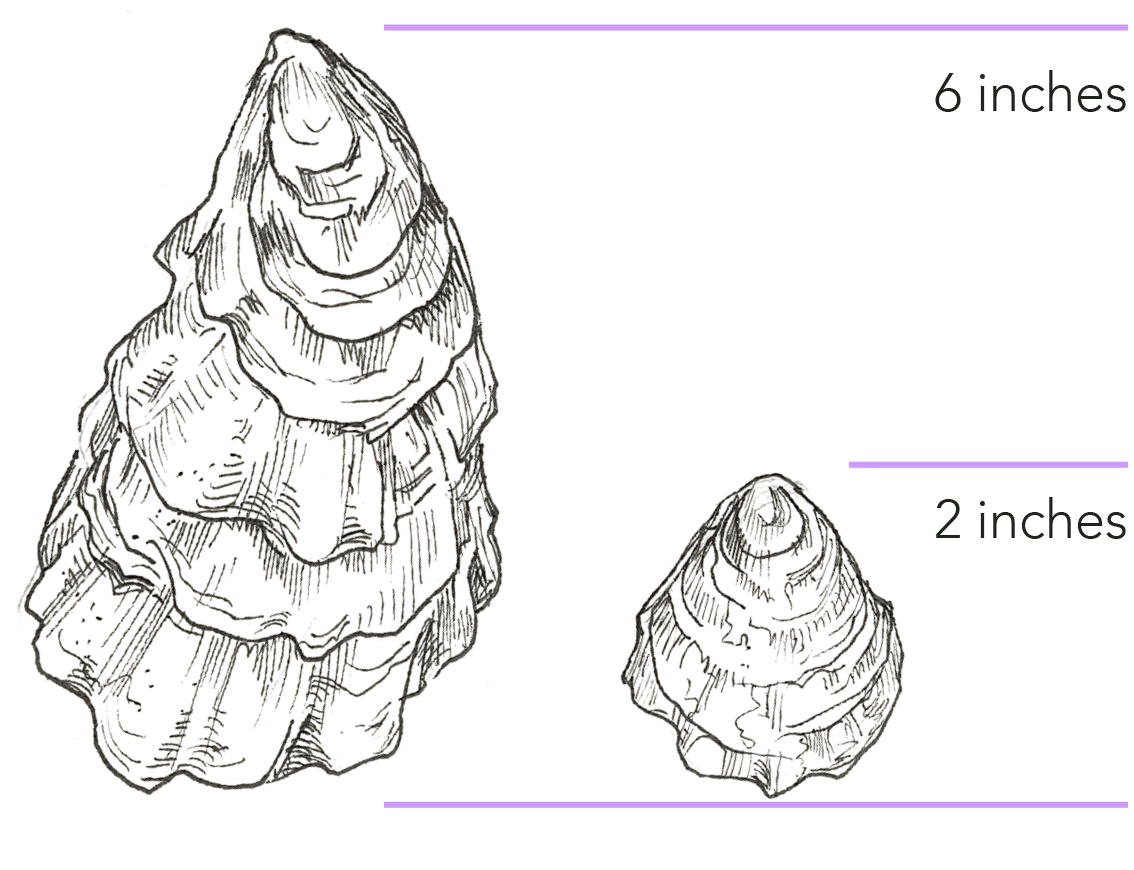
Mature Pacific oysters (left) are over three times the size of Olympia oysters (right) that rarely get over 2 inches long or wide. Olympia oysters love to settle on their bigger cousins.

The large Eastern oyster, Crassostrea virginica, grows into sculptural reefs in renowned habitats like New Yor k Harbor and the Chesapeake, creating three-dimensional structures with the big shells pointing their razor-sharp edges upward at random angles. Another familiar large oyster is the Pacific oyster, Crassostrea gigas, a native of Japan, that has become the farmed oyster of choice and the de facto culinary preference of oyster bars along the North American West Coast.

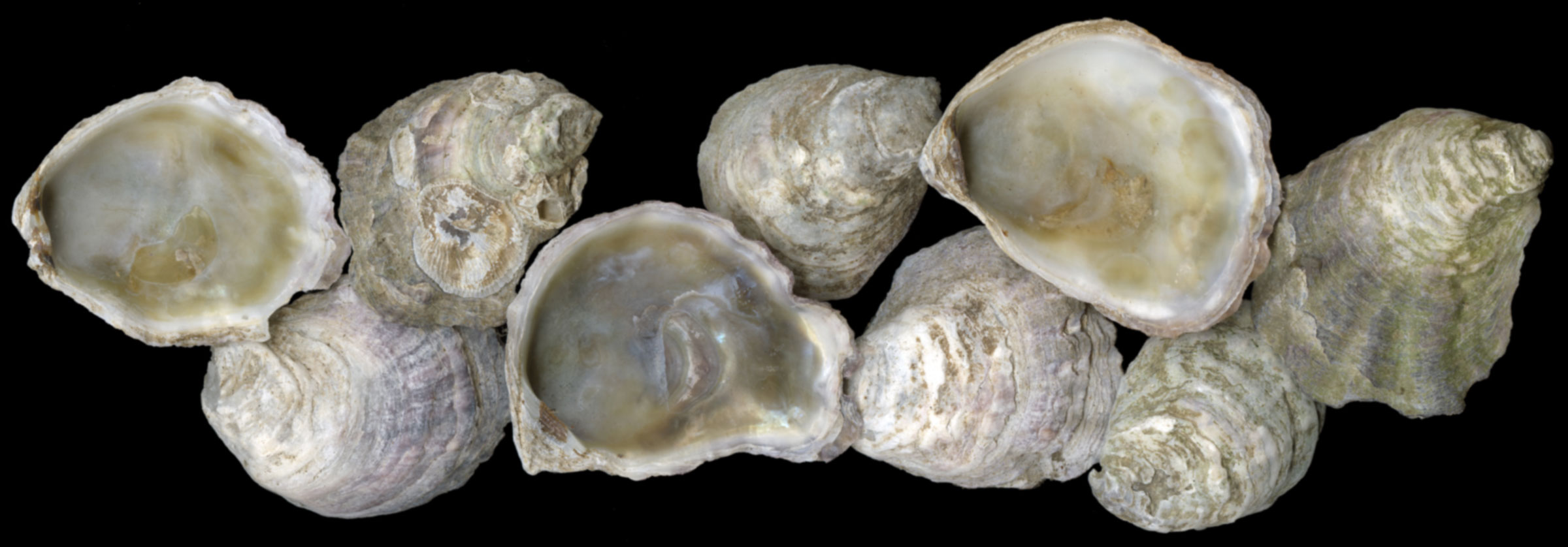
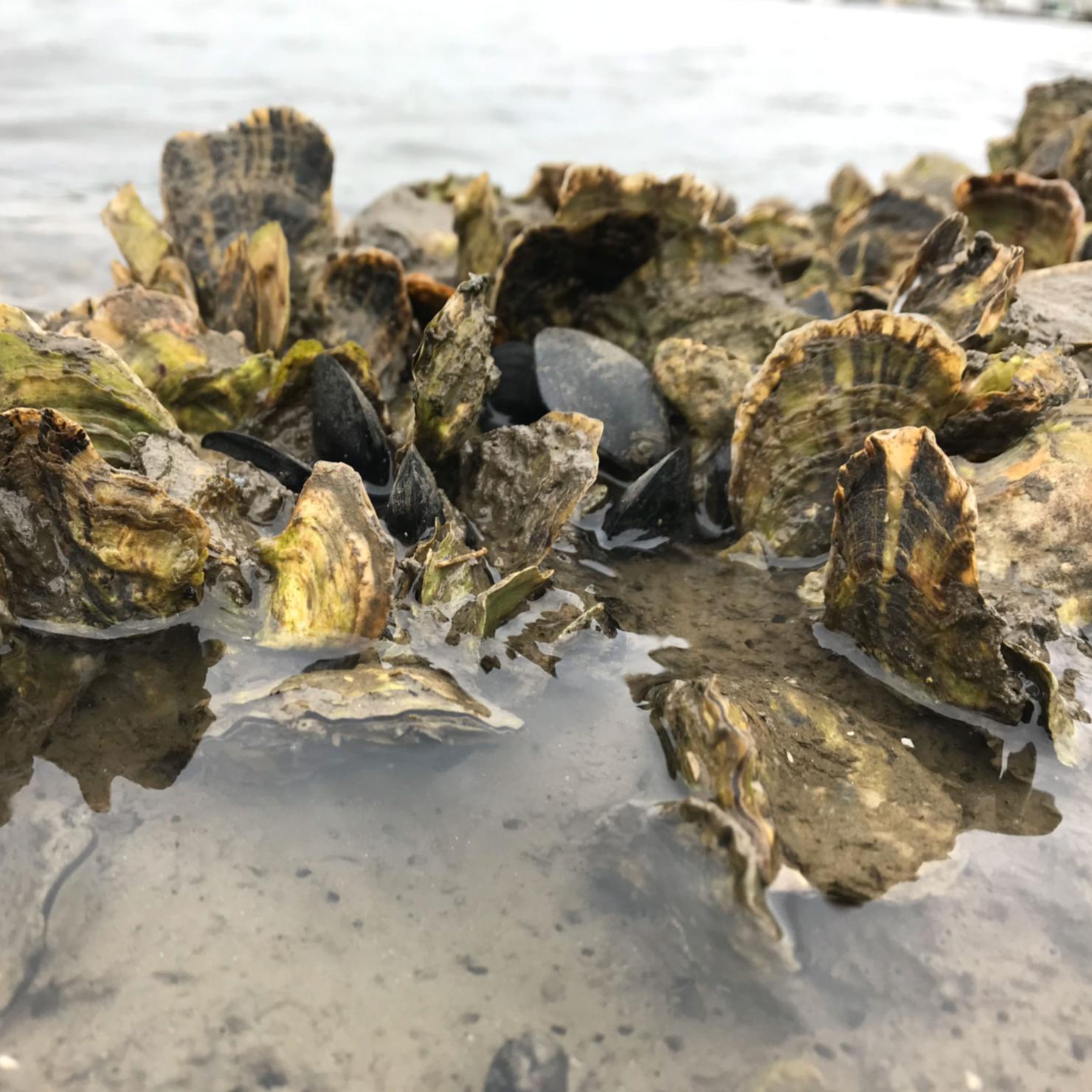
The native Olympia oyster, which once formed established beds in San Francisco Bay and along the outer coast, in Elkhorn Slough and Tomales Bay and is now found in isolated pockets on rocks and in crevices around the Bay, looks very different. It is often round rather than long, growing to no more than two inches or so as a maximum width, and is sometimes reddish, sometimes purply-striped on the outside with a coppery-green inside. It is remarkably flat. It is hard to imagine an organism alive in the compressed space between its valves, but it is there. Your nose will let you know if by chance an Oly is left out in the air too long.

How it Works

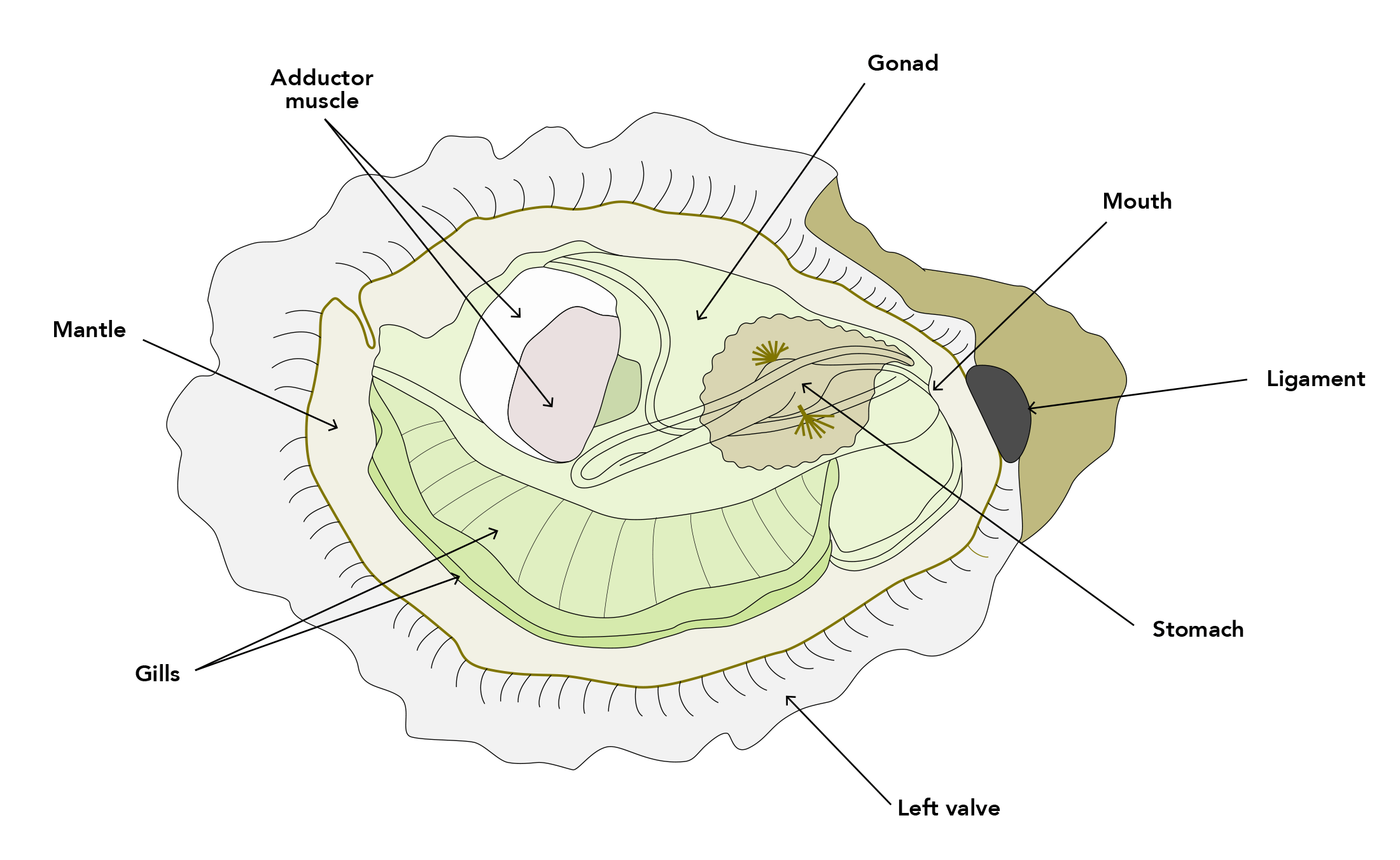
An Olympia oyster is a complex series of organs that can filter feed off small particles and breathe oxygen in ocean water.

Clamping Shut, Filtering Food, Building a Shell

Olympia oysters prefer a zone between water and land, the intertidal zone, where they are covered most of the day, but can survive during low tide when exposed to sun and wind. They clamp shut tightly using their strong adductor muscle and the ligament that operates the hinge of their valves (shells) trapping moisture within them, holding their breath (going anaerobic), until the ocean returns and they can get back to business. Olys are also fine living always submerged, in the deeper water. With their valves open their gills perform the dual function of breathing oxygen out of the seawater and filtering food.

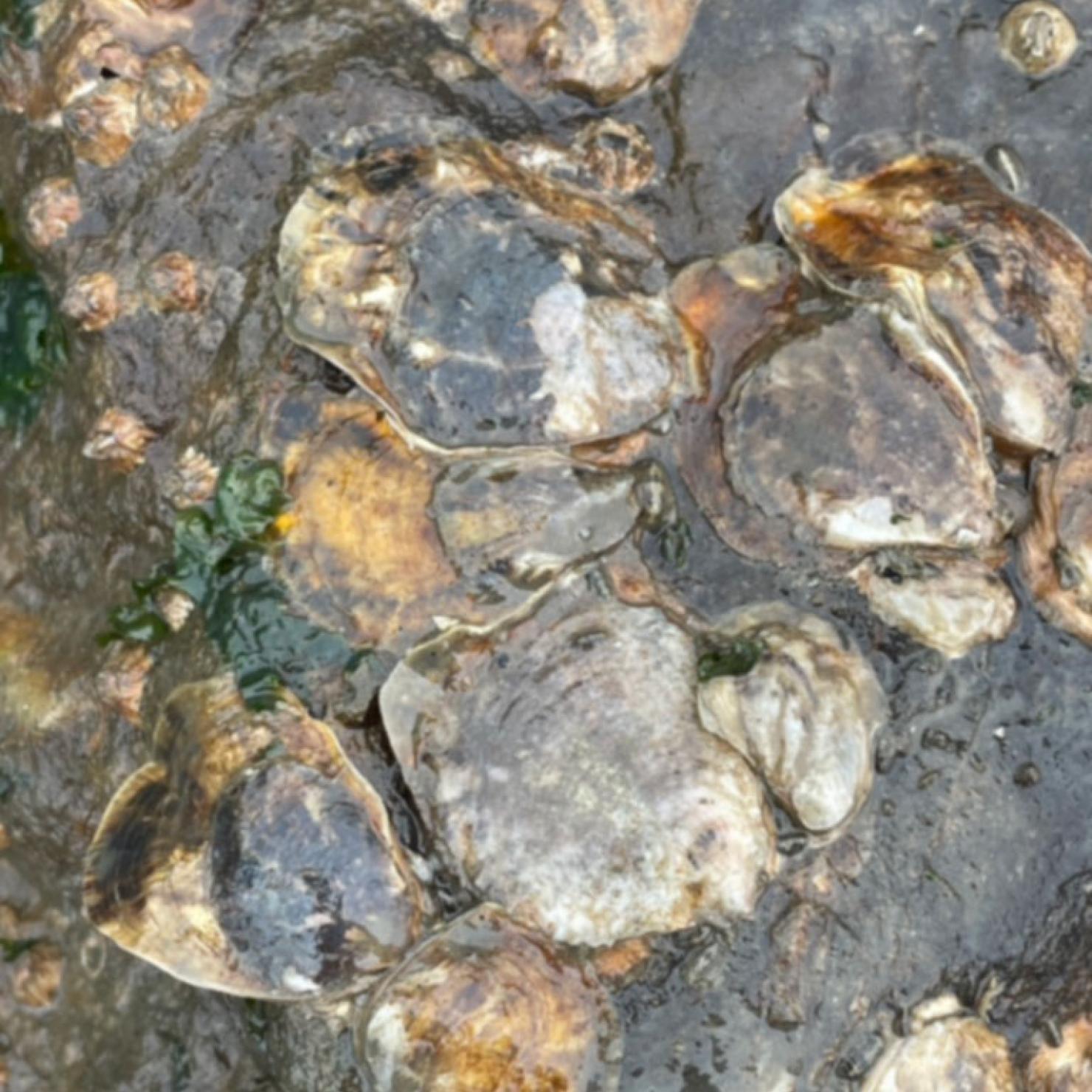
Olympia oysters on rock

Olys at Heron’s Head

Photo by Josie Iselin

Fantastic Filter Feeders

Olympia oysters have an extraordinary ability to feed off of the tiniest particle of the estuarine riches floating around, using “the best gills in the kingdom,” as described by Eleanor Clark in 1959. Cilia on the two gills beat in unison to pull water over the gills, which collect all kinds of microscopic material using a mucus film to capture phytoplankton, diatoms, sediment, and other organic matter. The gills are picky about what they accept to digest. The mainstay of the Oly diet is nutritious marine phytoplankton and diatoms, what it needs —for metabolic growth—to grow plump and build a shell. The rejects—bigger particles of organic matter that wash in from the Delta and Bay tributaries—stick to the mucus in the oysters’ filtering channels, aggregating into packets that are ejected through pores in the gills, flushed the opposite direction than the food, and out of the oyster, sinking in the water column to become nutritious tidbits for other bottom-dwellers in the mud. This process leaves the water column cleaner and clearer, a boon to photosynthesizers needing access to light.

How to Build a Shell

An oysters mantle is a remarkable organ. All of its organs are enclosed in this sack which not only fabricates every speck of shell the oyster will make, but is also in charge of the oyster’s sensory contact with the outside world. The mantle, open for the most part on all sides to allow water into the organs, extracts calcium from the ocean water, and glands of the mantle secrete the calcium carbonate shell as either aragonite or calcite. The crystalline structure of aragonite, laid down in microscopic layers, results in the shiny nacre on the inside, while most of the shell is made from the more stable calcite form of calcium carbonate.

Photo by Josie Iselin

Is it Mom or Dad?

The Olympia Oyster Life Cycle

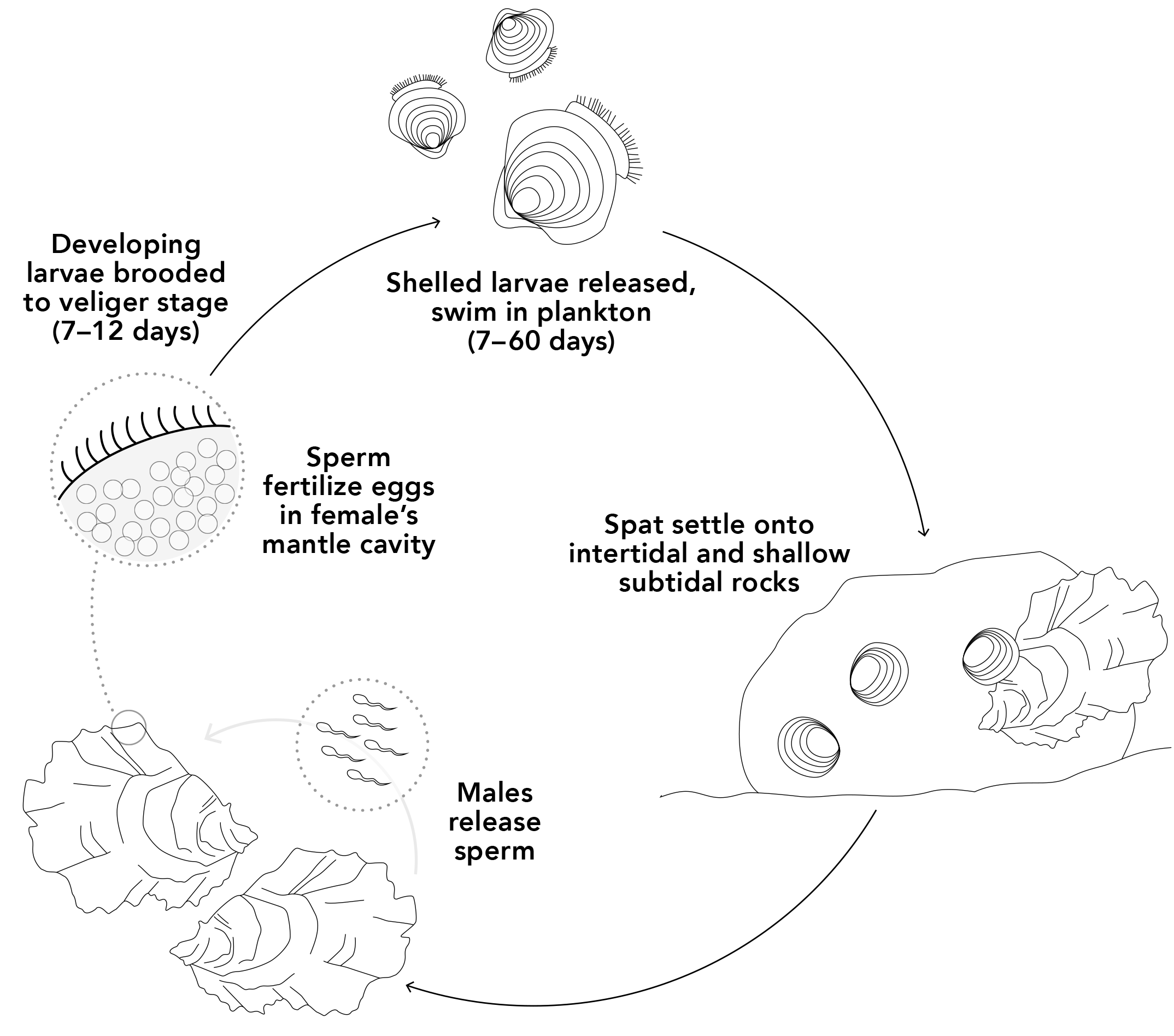
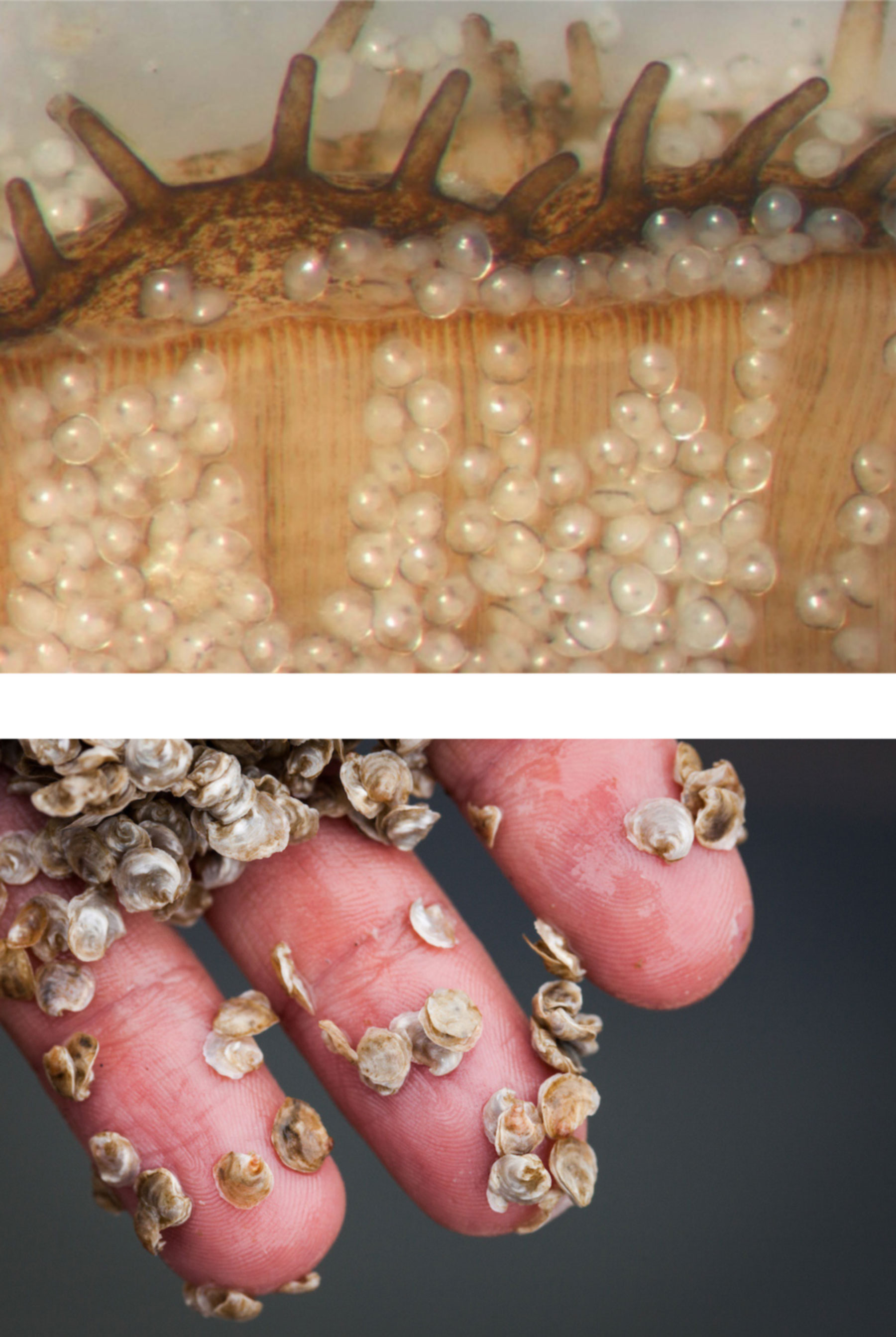
Like many other organisms, oysters make both male and female gonads and can change their sex. After starting life as male, and a first broadcast of sperm at about five to six months old, an Olympia oyster will then change sex regularly, being both female and male numerous times throughout its life. This, theoretically, keeps an ample number of males and females nearby for successful breeding, and ideally, different age classes will be represented in a given Oly bed. Females of many oyster species also broadcast their eggs for chance fertilization in the water column, but the female Olympia oyster and other Ostrea moms bring the sperm into their shells with respiratory action and fertilize them internally. The fertilized eggs then develop within the shell and start their own shell building…inside the mother Oly! In about ten (7-14) days, when the larvae are expelled into the surrounding waters, they already have a tiny shell, an advantage one would think when entering the wide world as estuarine plankton, oyster larvae.

As soon as seven days or as long as eight weeks of drifting, Oly larvae, if they haven’t been eaten, will use chemical cues to find a surface to settle on (often the underside of a surface!) and metamorphose into the sessile, fixed-in-place bivalve. The newly settled oyster is called “spat.”  The extended time the larvae spend floating with currents means that children often settle far from their parents, ensuring a mix of genes in each community of oysters that finally settle.

Olys grow slowly. They can spawn at 4-5 months of age but then take years (as quickly as 18 months but as slowly as 4 years) to reach their adult size of 1-2 inches wide. For wild Olympia oysters reproduction will only happen if the water temperature is warm enough. While Olys are at home in the cold Pacific, they generally are found in quieter bays and estuaries where the water temperature will rise above 60°F in the summer or fall to initiate spawning and allow the life cycle to begin again. A recent study noted that climate change and warming oceans may provide a positive boost to Olympia oyster reproduction.
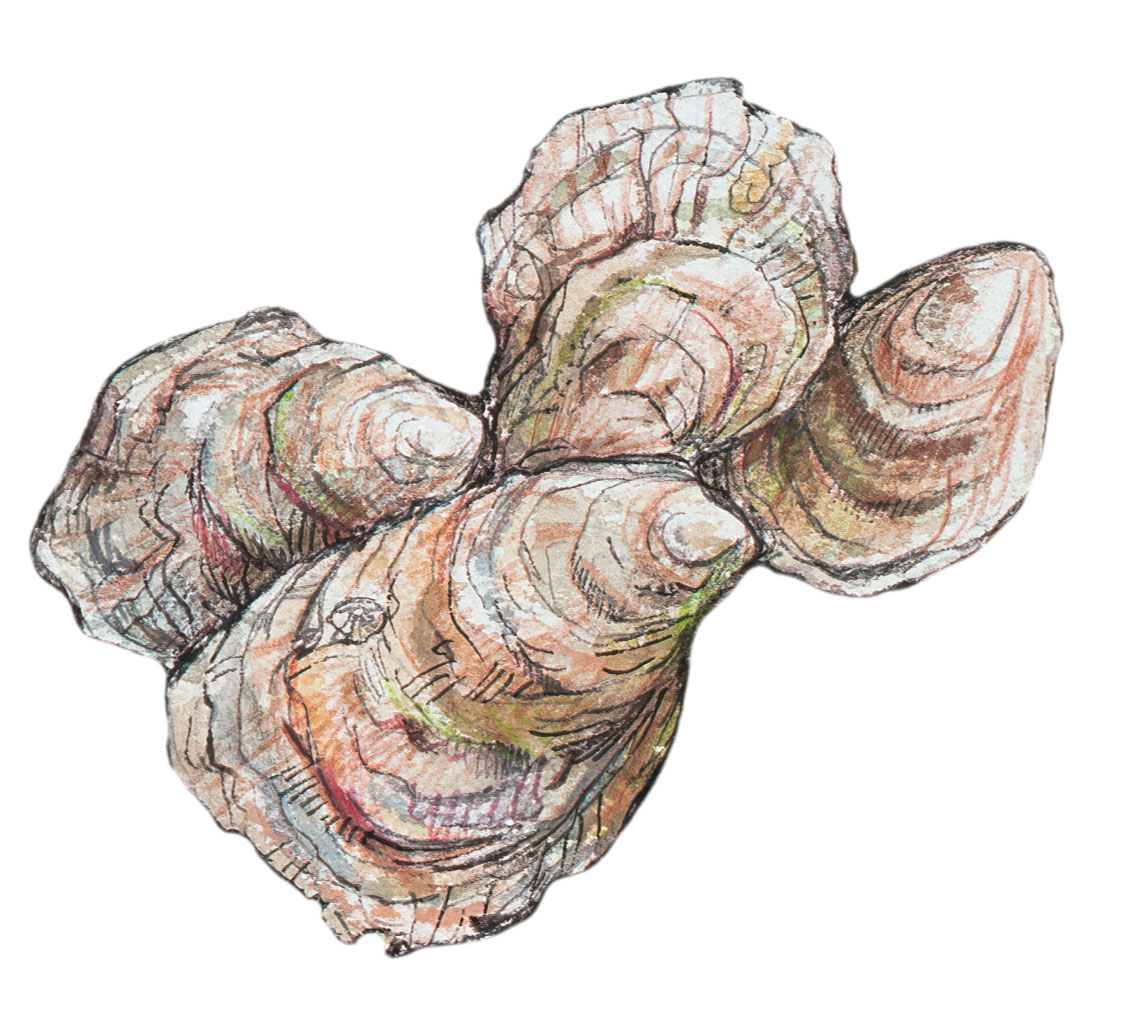
Olympia Oyster Life Cycle: Ostrea lurida and other oysters of this genus brood the fertilized larvae internally. The babies start shell building within the female oyster. After release from the mother oly larvae can travel great distances before settling.

Top: Eggs brooding within the Olympia oyster’s mantle

Bottom: Spat, or juvenile Olympia oysters have settled on tiny pieces of shell and are ready for distribution.

Top Photo by Jim Moore, CDFW

“Almost any normal oyster never knows from one year to the next whether he is he or she…”

MFK Fisher, Consider the Oyster

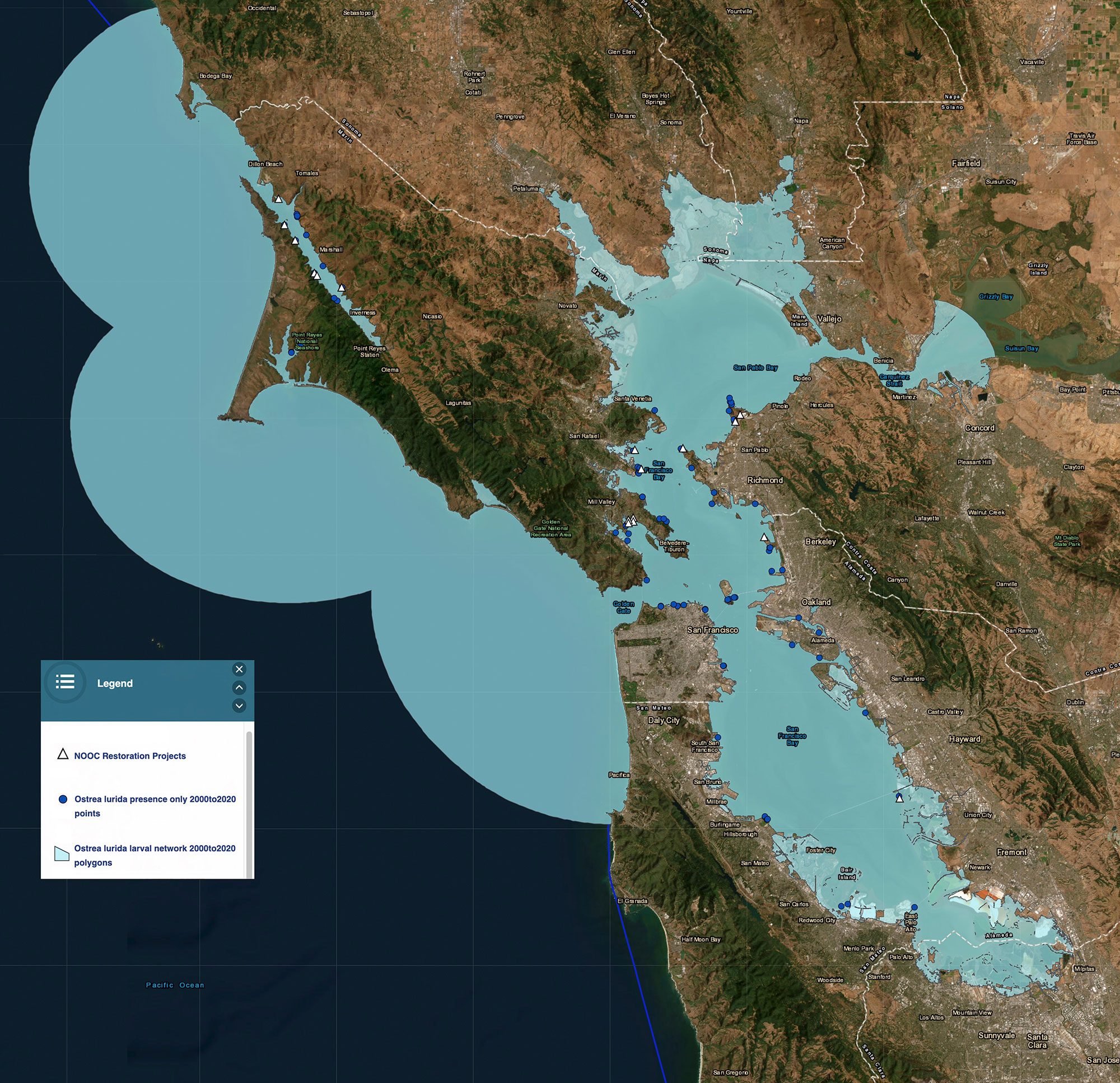
Olympia and Pacific Oyster Data Portal/NOAA & NOOC: The light blue fields of color indicate the extent of Olympia oyster larval distributions. Oly larvae can float as far north as Bodega Bay and into Tomales Bay and as far south as Devil’s Slide, south of Pacifica. The blue circles indicate Ostrea lurida presence from 2000–2020 using iNaturalist data and extended surveys. The White triangles are Olympia oyster restoration sites

Spreading the Wealth

Oly larvae, as zooplankton, feed the food chain, providing nutrients to all sorts of organisms at the lower levels of the trophic web, especially juvenile fish. Baby herring, anchovy, delta smelt, and salmonids (juvenile salmon) all eat plankton and small larvae —tiny, nutritious floating nuggets that help them grow to maturity. Oly larvae drift with the current for up to two months, covering quite a bit of distance if they survive to settle. They can even go in and out of the Golden Gate disbursing genetic material into and out of the Bay.   

Olys and SF Bay

A Healthy Partnership

Olympia oysters once formed vast beds on the mudflats of San Francisco Bay. Like coral reefs, multiple generations grew on top of each other, forming layer after layer of shells and providing a unique type of structured habitat, self-sustaining in the same way that eelgrass beds and salt marshes are. Those beds are virtually gone.

Restoration sites in the bay

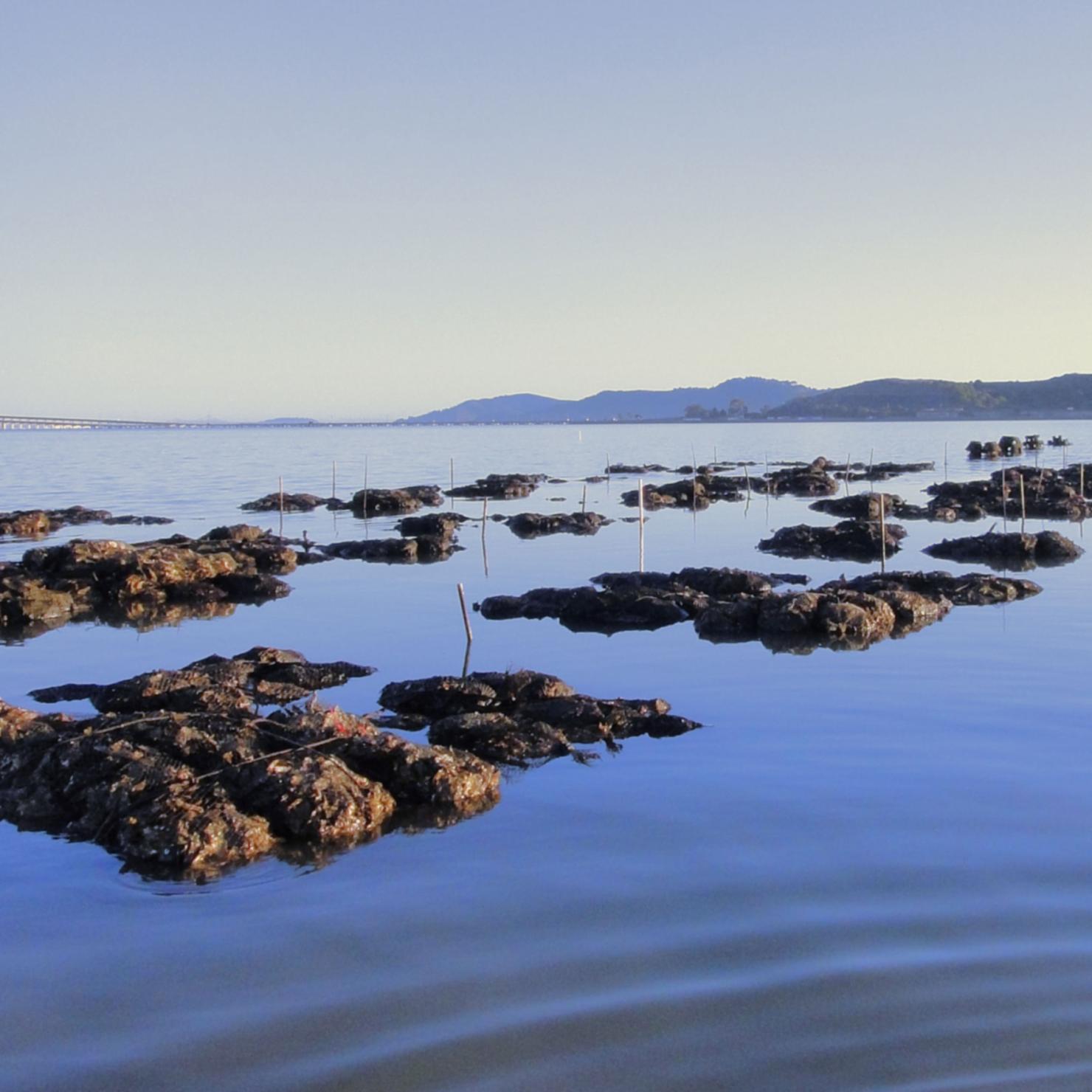
SF Bay Living Shorelines Project at San Rafael. Bags of Pacific oyster shells are set out in a large plot to create a dimensional reef for native oysters and other organisms to settle upon.

Photo by Stephanie Kiriakopolos/SCC

Today with few shell beds left, Olympia oysters within San Francisco Bay settle on varied and often surprising substrates. They have been found on pilings pulled from 60 feet of water, and near toxic outflows from refineries. They can live shallow or deep, on vertical surfaces or upside down. Olys are sensitive to salinity—large fresh water events will devastate an Oly community— and they need warm water to spawn successfully. They grow well in the rocky intertidal areas of SF Bay where these conditions come together. And the few remaining niches where Olys aggregate into beds are some of the most productive and biodiverse corners of the bay. The pockets of rough, uneven surfaces created by the layered oysters are a refuge and home to many. Small invertebrates and seaweed abound; larval stages of many organisms can grow to the next stage of their life cycle. Olys can be considered a barometer of Bay health. But Oly substrate in the Bay is forever getting covered with sediment or fill for human-centered development, such as docks wharves, pipelines or bridges. It is hard to keep clear from accumulating mud. Creating the conditions for these productive Oly beds to return to the San Francisco Bay is the challenge that many groups are taking on with research, experimentation, and gusto.

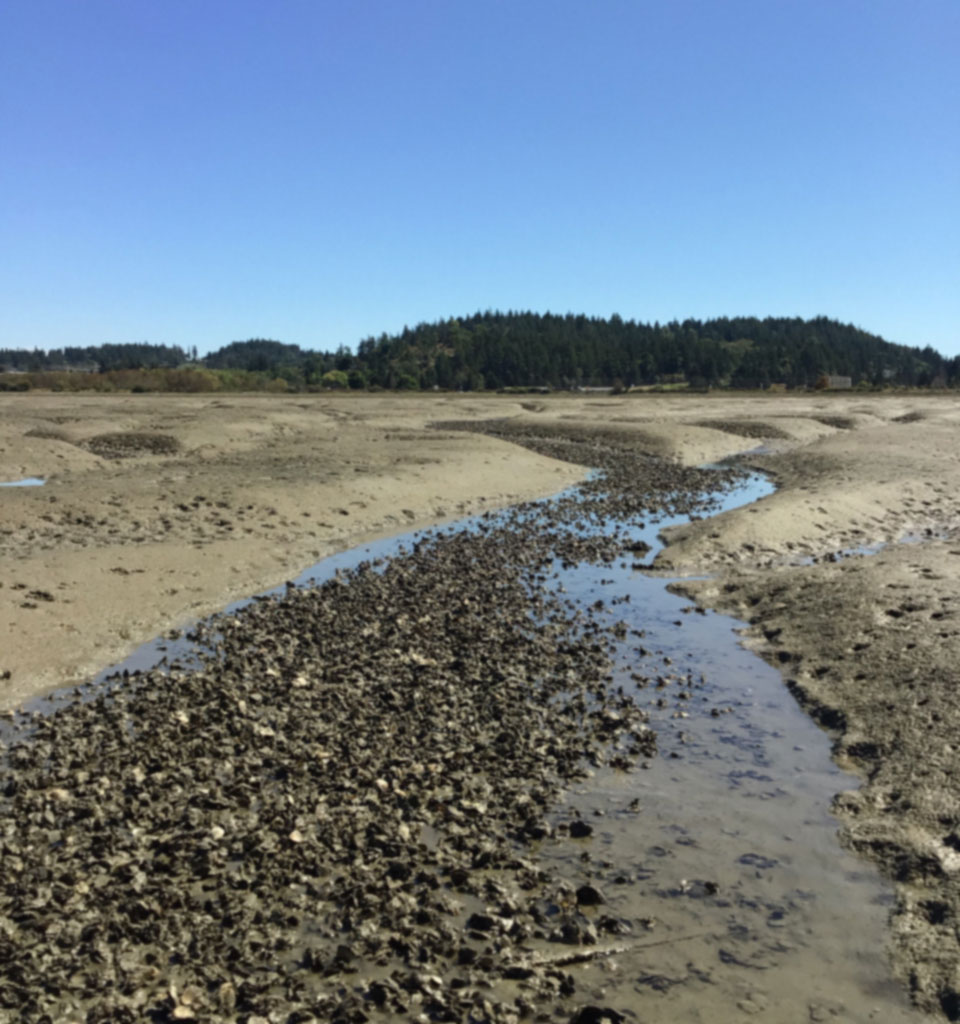
Fidalgo Bay in the north end of Puget Sound, where long term oyster restoration has been successful and Oly beds are thriving.

Photo by Josie Iselin

A Name of Place

History of Olys near Olympia

Olympia oysters are named after Olympia, the capital city of Washington State, at the very southern tip of Puget Sound. Olympia oysters have abounded in Puget Sound as the only native oyster for millions of years in a number of well known oyster bays, but are  “Most Abundant in Vicinity of Olympia” as announced in The Rise and Fall of Olympia Oysters by EN Steele, a 1957 account of the rich and complex history of the Olympia oyster and the consortium of oyster growers of lower Puget Sound. Early white pioneers to the region encountered the “very small oyster (Ostrea lurida) which had a distinct and delicious flavor” abundant in coves where “pure cool streams of water came into every cove; the salt water was pure and unpolluted.” The abundant oysters and clams have been relied upon as a staple food and asset of local Tribes, including the nearby Squaxin Island Tribe, for thousands of years. As settler populations grew through the 1800s, efforts to sustain and augment the natural beds for regular harvest and commerce promoted a spirit of cooperation, learning, and experimentation that continues to this day. The Olympia oyster is recognized in Puget Sound not only as a super food but also as a beloved organism that connects with the popular imagination. The spirit of the Oly is still strong in and around Puget Sound.

A Comparative Edge in a Changing Ocean?

A bed of Olys in San Diego

A bed of Olys in San Diego

Photo by Danielle Zacherle

Ostrea lurida thrived as the only oyster in the matrix of mollusks along the Pacific coast until overharvesting and habitat loss nearly wiped them out. Is brooding their young what gave Olys the advantage over other oysters, and could it be an advantage in the face of present-day increased ocean acidification? As oceans absorb the carbon dioxide emitted by the human indistrialized world, it becomes more acidic, making it harder for shell-building organisms to build their shells. The Oly  (when female) fertilizes her eggs internally, and because the resulting larvae remain in the mantle for up to two weeks, they are more robust upon entering the dangerous planktonic world of the water column. But perhaps more significantly, the Oly’s shell-building mechanism is built-in resistance to the lower pH that makes shell-building difficult for any newly forming mollusk. Unlike other oysters whose larvae have to start building shells within a six-hour window of fertilization or die, the Oly larvae have the luxury of time in their mamas mantle and take a few days before they even begin, and then they find the right conditions to begin accumulating calcium carbonate. This flexibility in timing allows the Olys to reserve energy and have a greater calcification success rate in acidic conditions.

This advantage in acidic conditions is yet another reason the small but mighty Oly could prove particularly resilient to changing oceans. Warmer seas? No problem. Olys appear to grow faster and survive well in higher temperature waters which will also favor increased reproduction. Rising seas? No problem. Olys thrive in deeper water as well as intertidal zones. More man-made substrates? Sure, Olys settle on just about anything.